

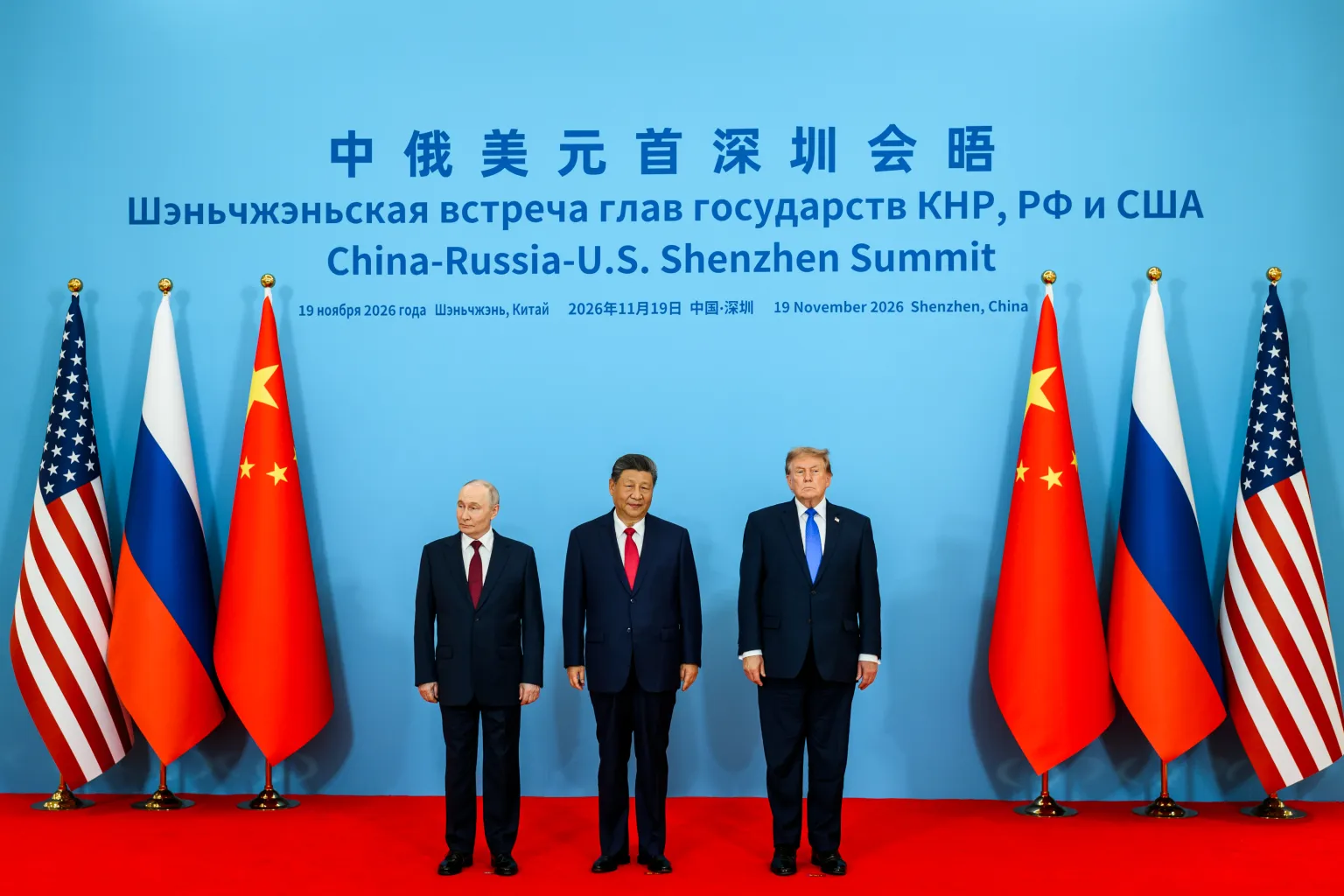
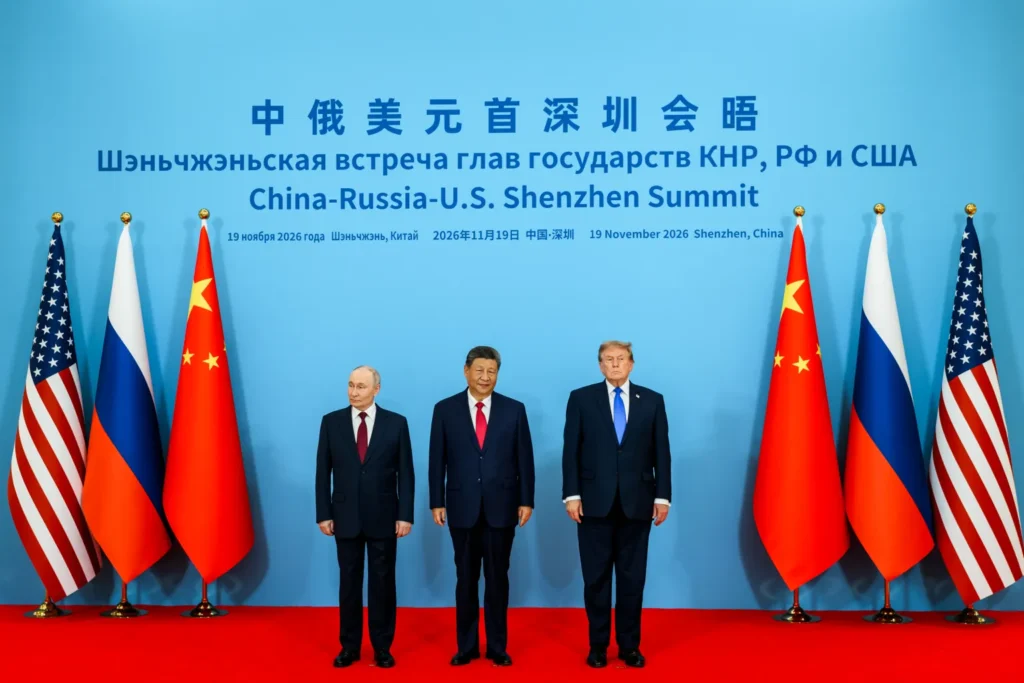
20th November 2026 Shenzhen, China | US President Donald Trump, Russian President Vladimir Putin and Chinese President Xi Jinping came together in Shenzhen, China, on 19th November 2026 for an unprecedented trilateral summit, bringing the leaders of three major world powers to the same negotiating table.
The meeting took place alongside the Asia-Pacific Economic Cooperation (APEC) Summit and followed a widely reported handshake between Trump and Putin on 18th November, with Xi Jinping standing nearby.
Their encounter attracted international attention because the United States, Russia and China play central roles in global security, nuclear weapons policy, international trade and diplomatic relations.
The three presidents subsequently issued a joint declaration titled “U.S.-Russia-China Heads of State Declaration toward Peace,” outlining shared commitments concerning nuclear risk reduction, international security, United Nations reform and energy cooperation.
However, the declaration did not announce an agreement to end the war in Ukraine or resolve the broader disagreements between the three governments.
So why did the leaders come together, what was the significance of their handshake, and what could the discussions mean for the wider world?
Why Did Trump, Putin and Xi Jinping Meet in China?
The immediate reason was China’s decision to host a trilateral meeting alongside the 2026 APEC Summit.
With all three presidents already attending the international gathering in Shenzhen, the occasion provided an opportunity to discuss major security issues directly.
China formally announced the planned meeting on 16 November, ahead of the leaders’ arrival.
According to China’s Ministry of Foreign Affairs, the discussions focused on safeguarding world peace and promoting strategic stability in relations among major powers.
The three countries are permanent members of the United Nations Security Council and possess some of the world’s largest nuclear weapons capabilities.
Their decisions can influence international security arrangements, economic sanctions, energy markets and diplomatic responses to conflicts.
The summit therefore presented an opportunity for dialogue between governments that cooperate in certain areas while maintaining significant disagreements in others.
Why Did Trump and Putin Shake Hands as Xi Jinping Looked On?
On 18 November, Donald Trump and Vladimir Putin exchanged a handshake during the APEC welcome events in Shenzhen, with Chinese President Xi Jinping nearby.
The encounter took place as world leaders gathered for the summit’s diplomatic programme.
Photographs of the greeting circulated internationally, drawing attention to the presence of the three presidents at the same event.
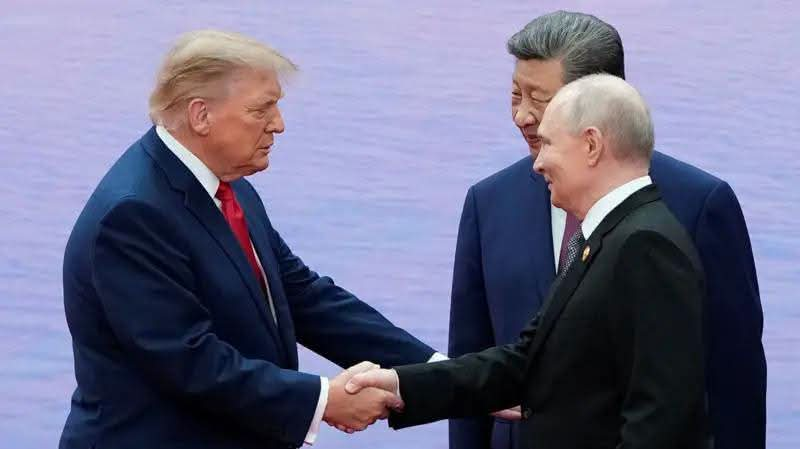
Although a handshake between political leaders is a customary diplomatic gesture, this particular exchange attracted interest because relations between Washington and Moscow remain complicated by the war in Ukraine, sanctions and international security disagreements.
Xi’s presence also highlighted China’s role as host of the gathering and organizer of the following day’s trilateral talks.
Importantly, the handshake itself was not an agreement.
It represented a public diplomatic exchange ahead of more substantive discussions between the three governments.
What Happened During the 19th November Trilateral Meeting?
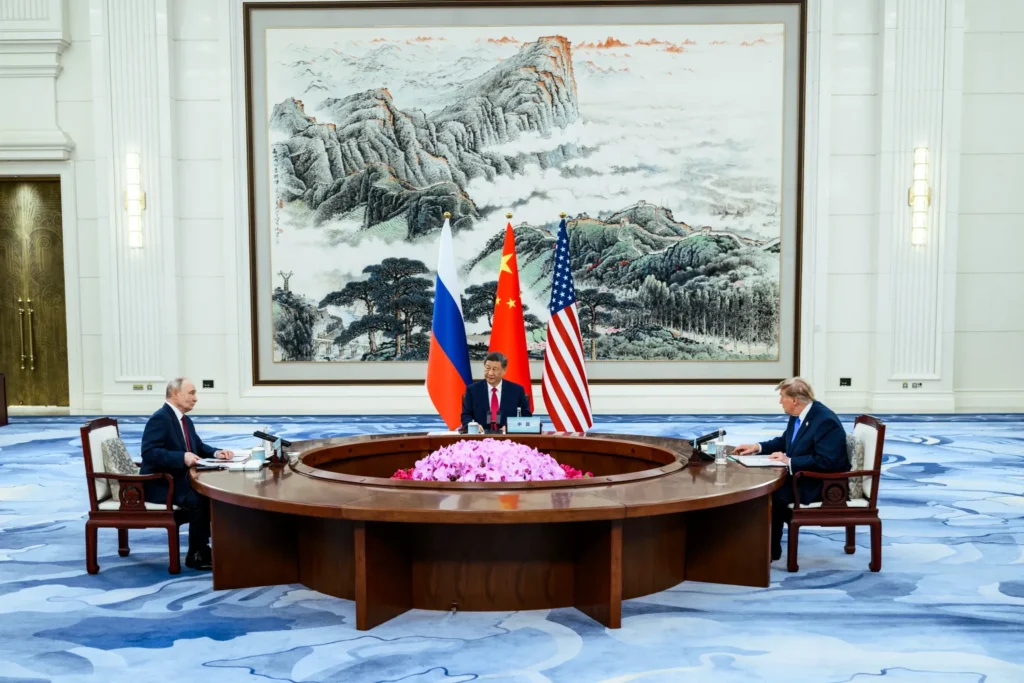
The three presidents met at Kylin Villa in Shenzhen on Thursday, 19th November.
The meeting was hosted by Xi Jinping and focused on international peace, strategic stability and relationships between the three powers.
Official photographs showed the presidents seated around a conference table, with the flags of China, Russia and the United States displayed behind them.
What Did Xi Jinping Say?
President Xi Jinping described the trilateral gathering as a significant development in relations between the three countries.
He emphasized the importance of mutual respect, peaceful coexistence, economic cooperation and continued dialogue.
Xi argued that major powers have particular responsibilities to help maintain international peace.
He also supported keeping communication channels open to reduce misunderstandings and prevent disagreements from escalating into wider conflicts.
What Did Donald Trump Say?
President Trump highlighted the importance of cooperation between the world’s major nuclear powers.
He emphasized the need to reduce the risks associated with nuclear weapons and prevent further nuclear proliferation.
Trump presented direct communication as an important part of managing international disagreements and expressed interest in further cooperation with Xi and Putin.
His remarks suggested that the meeting was intended to begin a longer diplomatic process rather than settle every outstanding issue immediately.
What Did Vladimir Putin Say?
President Putin welcomed the opportunity for direct engagement between the three leaders.
He emphasized the responsibility of major powers to maintain international peace and security.
Putin also highlighted national sovereignty, mutual respect, energy security and international cooperation as important subjects.
Russia expressed interest in continued dialogue with China and the United States, including on issues where the countries hold different positions.
What Did the Three Presidents Actually Agree On?
Following their discussions, the governments released a joint declaration containing four principal commitments.
1. United Nations Reform
The three countries committed to pursuing reforms intended to improve the United Nations’ ability to address international challenges and support peace and security.
However, the declaration did not specify a completed reform package, an implementation timetable or changes to Security Council membership.
2. Energy Cooperation
The leaders expressed support for stable international energy supplies.
They also outlined plans to increase the production and availability of refined petroleum products.
Energy prices and supply disruptions can affect transportation, manufacturing and household costs worldwide.
However, the declaration did not establish a detailed implementation plan for the proposed increases.
3. International Criminal Court and State Immunity
The declaration addressed the principle of state consent and legal immunities for government officials.
The leaders stated that international courts should not misuse their jurisdiction.
This was one of the more contentious elements of the declaration because the International Criminal Court has issued an arrest warrant for Vladimir Putin in connection with alleged unlawful deportations of Ukrainian children.
The ICC maintains that its jurisdiction and legal processes operate under the Rome Statute, while Russia does not recognise the court’s jurisdiction over its officials.
The declaration therefore raises questions about how the three governments approach international accountability and existing judicial institutions.
4. Nuclear Risk Reduction
The three presidents reaffirmed that nuclear war must never be fought.
They also committed to dialogue aimed at reducing nuclear risks and preventing the spread of nuclear weapons.
This commitment was significant because the United States, Russia and China are central to international nuclear security discussions.
Nevertheless, the declaration did not announce a binding nuclear disarmament treaty, numerical weapons reductions or an agreed verification framework.
Was the War in Ukraine Discussed?
Yes. According to the Chinese Government’s official account, the leaders exchanged views on the Ukraine conflict, alongside developments in the Middle East and the Korean Peninsula.
The war remains a major source of disagreement between Russia and Western governments.
Ukraine and its international partners have emphasized the importance of sovereignty, territorial integrity and a settlement consistent with international law.
Russia has presented its own security and political demands.
Although the discussions provided an opportunity for diplomatic exchanges, the joint declaration contained no specific ceasefire agreement, peace settlement or timetable for ending the conflict.
It would therefore be inaccurate to interpret the meeting as a resolution of the Ukraine war.
What Could This Meeting Mean for the World?
Nuclear Security and International Stability
Direct communication between the three major nuclear powers may provide opportunities to reduce misunderstandings and discuss future arms-control arrangements.
Any measurable progress would depend on subsequent negotiations, commitments and verification mechanisms.
International Energy Markets
Discussions about increasing refined petroleum supplies could become relevant to fuel prices and energy availability.
However, an announcement of intent does not automatically translate into increased production or lower prices.
Global Diplomacy
The meeting demonstrated that governments with competing interests can still participate in direct negotiations.
It also raised questions about how major-power cooperation would affect other countries and international institutions.
Australia and New Zealand
Although neither Australia nor New Zealand participated in the trilateral talks, their economies are connected to developments in international trade, energy and regional security.
Changes affecting major-power relations could influence economic confidence, global shipping, investment and diplomatic priorities.
However, any direct implications would depend on concrete policy decisions following the summit.
Does This Mean the United States, Russia and China Are Becoming Allies?
Not necessarily.
The three countries maintain different political systems, strategic interests and international relationships.
They may cooperate on specific issues while continuing to disagree over sanctions, military policy, technology restrictions and regional security.
A joint declaration is evidence of agreement on its stated subjects, but it does not automatically establish a military alliance or a wider strategic partnership.
The distinction is particularly important because the summit produced commitments to further dialogue rather than comprehensive resolutions of existing disputes.
What Happens Next?
The next developments will depend on whether the governments establish formal negotiations, release implementation plans or announce additional agreements.
Future nuclear-risk discussions will be particularly important to monitor.
International reactions to the declaration’s language on the ICC, the United Nations and global energy supplies may also shape the diplomatic conversation.
For now, the Shenzhen meeting represents a new channel of direct engagement between the three presidents.
A Handshake, a Historic Meeting and Unanswered Questions
The Trump-Putin handshake on 18th November was a visible moment of diplomacy, but the more substantial development occurred the following day when the leaders of the United States, Russia and China met together.
Their joint declaration identified several areas in which the governments expressed a willingness to cooperate.
At the same time, major disagreements remain, and the summit did not produce a comprehensive peace agreement or binding nuclear arms reduction arrangement.
The significance of the meeting will ultimately depend on whether the commitments announced in Shenzhen lead to practical negotiations and measurable outcomes.
For the wider world, the central question is not simply why the three leaders appeared together, but what their governments will do next.
Key Highlights of the Trump-Putin-Xi Jinping Meeting
- The three presidents met in Shenzhen on 19th November during the APEC 2026 gathering.
- Trump and Putin exchanged greetings on 18th November, with Xi Jinping present.
- The meeting was the first trilateral summit involving the sitting leaders of the United States, Russia and China.
- Nuclear weapons, international security, the Ukraine war and developments in the Middle East were among the issues discussed.
- The three leaders issued a four-point declaration addressing UN reform, energy supplies, international legal jurisdiction and nuclear risks.
- The declaration included a commitment to further dialogue on nuclear risk reduction and preventing nuclear proliferation.
- No peace agreement ending the Ukraine war or binding nuclear arms reduction treaty was announced.
Editorial Note
This article is based on official statements released by the White House and China’s Ministry of Foreign Affairs following the 19th November 2026 trilateral summit, alongside contemporary international reporting. The 18th November handshake and 19th November formal meeting are treated as separate events. Announced commitments are distinguished from completed agreements.
Inside APEC Summit 2026: Major Leaders, Trade Talks and the Future of the Global Economy
Trump and Putin Shake Hands at APEC 2026 as Xi Jinping Looks On
QUAD Leaders Meet After Two Years: What Did Trump, Modi, Takaichi and Albanese Agree On?