

SAARC Advances South Asian Cooperation on Animal Health and Child Protection
July . 2026 : Two regional meetings held in Colombo in June 2026 highlighted the breadth of cooperation taking place across South Asia, with SAARC member states and international partners focusing separately on strengthening animal health systems and accelerating efforts to protect children from violence.
The Tenth Meeting of the SAARC Chief Veterinary Officers’ Forum, which began on 18 June, brought veterinary authorities together to strengthen cooperation on animal health, livestock productivity and food security. Less than a week later, Colombo hosted the South Asia Ministerial Conference on Ending Violence Against Children on 23-24 June, bringing governments and international organizations together around child protection, prevention and stronger support systems.
Although the two meetings addressed very different policy areas, both reflected a common regional approach: bringing national authorities, technical specialists and international organizations together to address challenges that frequently extend beyond national borders.
SAARC Chief Veterinary Officers Meet in Colombo
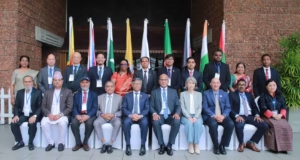
The Tenth Meeting of the SAARC Chief Veterinary Officers’ (CVOs) Forum began in Colombo, Sri Lanka, on 18 June 2026 as a two-day regional meeting focused on veterinary services, livestock development and regional cooperation.
Chief Veterinary Officers from Bangladesh, Bhutan, India, Maldives, Nepal, Pakistan and Sri Lanka participated alongside representatives of regional and international development organizations.
The event was jointly organized by the Agriculture and Rural Development Division of the SAARC Secretariat, Sri Lanka’s Department of Animal Production and Health, the World Organization for Animal Health (WOAH) and the Food and Agriculture Organization of the United Nations (FAO).
SAARC described the forum as an effort to strengthen coordination among South Asian veterinary authorities and support sustainable livestock productivity, food security and rural livelihoods. The SAARC Secretariat also publicly confirmed the opening of the tenth CVO forum in Colombo on 18 June.
Animal Health Linked to Food Security and Rural Economies
Animal health is closely connected with agricultural productivity, food supply, farmer livelihoods and the ability of countries to safely trade livestock and animal products.
During the opening session, D.P. Wickramasinghe, Secretary to Sri Lanka’s Ministry of Agriculture, Livestock, Land and Irrigation, welcomed participating delegations and emphasized the relationship between safeguarding animal health, maintaining food safety, supporting rural economies and facilitating regional trade.
The meeting provided veterinary authorities with a regional platform for discussing common priorities and strengthening cooperation between countries.
This type of coordination can become particularly important when dealing with animal diseases capable of affecting livestock across borders. Veterinary surveillance, early detection, disease reporting and cooperation among national authorities can all contribute to limiting economic and agricultural disruption.
SAARC Calls for Greater Support for Livestock Development
SAARC Secretary General Md. Golam Sarwar thanked the Government of Sri Lanka for hosting the technical meeting and acknowledged the continuing involvement of WOAH and FAO.
He also called on development partners to provide further technical, logistical and financial cooperation for SAARC initiatives connected with livestock development.
Representatives from Sri Lankan authorities, WOAH, FAO and the SAARC Agriculture Centre also addressed the meeting.
Dr. Tomoko Ishibashi, WOAH Regional Representative for Asia and the Pacific, acknowledged cooperation among SAARC institutions and Sri Lanka in organizing the gathering.
FAO representative Dr. Scott Newman highlighted the CVO Forum’s role as a technical platform for animal-health cooperation within South Asia, while Dr. Harunur Rashid, Director of the SAARC Agriculture Centre, emphasized the Centre’s thematic work and regional commitments.
The meeting opened with a strong emphasis on collaboration among participating countries and institutions on animal health and welfare.
Why Regional Veterinary Cooperation Matters
Livestock systems do not operate in isolation from wider regional challenges.
Animal diseases can affect agricultural production, farmer incomes, food availability and trade. Diseases capable of moving between countries also create a strong case for communication between veterinary authorities.
For South Asia, cooperation through mechanisms such as the CVO Forum provides participating governments with an opportunity to exchange technical experience, discuss veterinary priorities and improve coordination between national systems.
The forum also demonstrates how SAARC cooperation can extend beyond high-level diplomatic meetings into specialized areas involving scientists, veterinarians, agricultural institutions and government officials.
The SAARC Agriculture Centre has previously used regional consultations and CVO meetings to address livestock and transboundary animal-health issues, illustrating the longer-term role of technical cooperation within the region.
South Asian Countries Strengthen Efforts to End Violence Against Children
Just days after the veterinary meeting, Colombo hosted another major regional gathering this time focused on the safety and wellbeing of children.
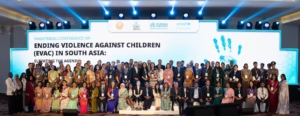
The South Asia Ministerial Conference on Ending Violence Against Children (SAMC-EVAC) was held on 23-24 June 2026.
The conference was convened by SAARC, the Government of Sri Lanka, the UNICEF Regional Office for South Asia, the World Health Organization’s South-East Asia and Eastern Mediterranean regional offices, and the Office of the Special Representative of the UN Secretary-General on Violence Against Children.
Ministers, senior government representatives, child-protection specialists, development partners and regional experts participated in discussions aimed at accelerating efforts to prevent and respond to violence against children across South Asia.
Focus on Physical, Emotional, Sexual and Online Violence
The conference addressed different forms of violence affecting children, including physical, emotional and sexual violence as well as risks arising in online environments.
Participants stressed that exposure to violence can have consequences extending into children’s health, education, safety and future opportunities.
Sri Lankan Prime Minister Dr. Harini Amarasuriya emphasized the responsibility of societies to create environments in which children can grow up free from violence, fear and exploitation.
The conference treated ending violence against children not only as a child-rights responsibility but also as a wider development issue.
Participants highlighted investment in prevention, family support, social protection and comprehensive child-protection systems as important components of building safer and more resilient communities.
Building on Earlier International Commitments
The Colombo conference followed earlier international and regional initiatives aimed at accelerating action against violence involving children.
Participants reviewed progress following the First Global Ministerial Conference on Ending Violence Against Children, held in Bogotá, Colombia, in November 2024.
They also built on a regional ministerial information-sharing meeting held in Kathmandu on 23 June 2025, which focused on elevating the Ending Violence Against Children agenda in South Asia.
Countries discussed progress involving:
- stronger legal and policy frameworks;
- expanded child-protection services;
- improved mechanisms for reporting and responding to violence;
- violence-prevention initiatives;
- positive parenting programmes; and
- stronger cooperation between government institutions.
The Colombo meeting therefore represented part of a continuing process rather than an isolated conference.
Child Protection Requires Cooperation Across Government
One of the central themes of the conference was that preventing violence against children cannot be handled by a single government ministry or institution.
Health services may identify injuries or abuse. Schools and education systems interact with children on a daily basis. Police and justice systems deal with serious offences and legal protection. Social-welfare agencies provide family and child support, while community organizations can play important roles in prevention and early intervention.
The conference consequently emphasized coordination across health, education, justice, social welfare, development and law-enforcement systems.
Delegates also discussed strengthening data systems, professional capacity, social-protection programmes and prevention services.
WHO emphasized that violence against children is preventable and that decisions taken by governments can contribute to breaking longer-term cycles connecting violence with poor health and poverty.
Children’s Voices Included in Regional Discussions
The Colombo conference also incorporated the perspectives of young people.
Sasindu Ranmith, a 17-year-old Sri Lankan student and President of the National Children’s Council, addressed difficulties some children face in knowing where to seek assistance or trusting available protection systems.
Including children’s perspectives added another dimension to discussions traditionally dominated by governments, institutions and development organizations.
The conference’s broader Call to Action focused on strengthening implementation of child-protection strategies, improving monitoring and encouraging greater regional cooperation through whole-of-government and whole-of-society approaches.
From Commitments to Implementation
A recurring message from the child-protection meeting was that laws and political commitments alone cannot eliminate violence against children.
Governments also require functioning reporting mechanisms, trained personnel, accessible services, prevention programmes, reliable information systems and cooperation across institutions.
UNICEF highlighted the importance of combining legislation with changes in attitudes surrounding how children are raised, educated and protected.
Delegations consequently exchanged experiences and approaches involving education, healthcare, justice, law enforcement, social protection and community-based systems.
SAARC, UNICEF, WHO and the Office of the Special Representative of the UN Secretary-General on Violence Against Children reaffirmed their intention to continue supporting governments as commitments are translated into practical measures and measurable outcomes.
Two Meetings, Two Different Challenges, One Regional Cooperation Approach
The two Colombo meetings demonstrate the variety of issues addressed through regional cooperation in South Asia.
The SAARC Chief Veterinary Officers’ Forum operates primarily as a specialized technical mechanism, bringing together veterinary authorities and organizations involved in animal health and agriculture.
The South Asia Ministerial Conference on Ending Violence Against Children, meanwhile, brought together political leaders, government officials and international organizations around a major social and child-protection challenge.
There is no direct policy connection between animal health and child protection. However, the two June meetings illustrate how regional institutions can provide platforms for cooperation across very different areas of development.
In animal health, collaboration can support disease preparedness, livestock productivity, rural livelihoods and food security.
In child protection, cooperation can encourage stronger prevention systems, information sharing, coordinated public services and implementation of national and international commitments.
For SAARC, such technical and sector-specific forums also provide practical channels through which member states can continue working together on shared regional priorities.
What to Watch Next
The longer-term significance of both meetings will depend on implementation.
For veterinary cooperation, important areas to watch include continued coordination between Chief Veterinary Officers, collaboration on transboundary animal diseases, veterinary capacity and further support from organizations such as FAO and WOAH.
For child protection, attention will increasingly turn toward whether national commitments result in stronger services, better reporting systems, prevention measures, workforce development and measurable reductions in violence.
The June meetings therefore represent steps within much longer regional processes rather than final outcomes.
Primary information for this article is based on official releases and information from the SAARC Secretariat, World Health Organization, UNICEF, the United Nations Office of the Special Representative of the Secretary-General on Violence Against Children, and associated regional institutions.
Editorial Note: This article provides an independent summary of regional developments based primarily on information published by SAARC and participating international organizations. It is intended for news, informational and educational purposes. Readers seeking detailed policy documents, commitments or programme information should consult the respective organizations and national authorities directly.
OECD Ministers Conclude 2026 Meeting on Industrial Policies and Open Markets