

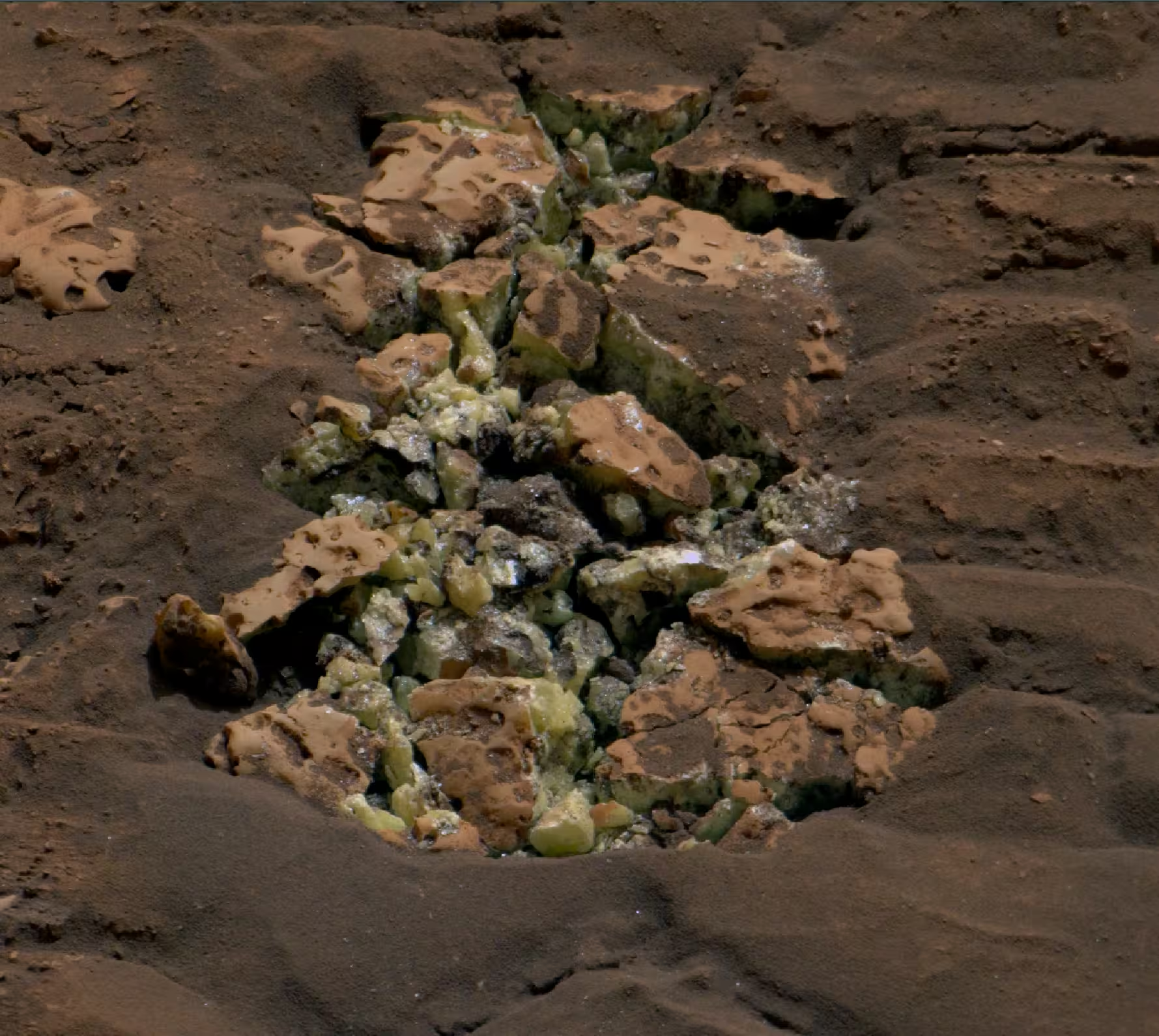
17 November 2026 | Science & Space | A NASA rover exploring the surface of Mars accidentally cracked open a rock and revealed something scientists had never previously identified on the Red Planet: yellow crystals of pure sulfur.
The unexpected discovery, made by NASA’s Curiosity rover in May 2024, has become the focus of renewed scientific attention following two studies published in 2026 that offer possible explanations for how the unusual deposits formed.
The findings could help researchers understand the ancient geological and chemical conditions on Mars, including processes that may have operated billions of years ago.
What Did NASA’s Curiosity Rover Actually Discover?
On 30 May 2024, NASA’s Curiosity rover was travelling through Gediz Vallis, a channel within Gale Crater, when one of its wheels rolled over a rock and broke it open.
Inside were pale yellow crystals that researchers subsequently identified as elemental sulfur – sulfur in its relatively pure form.
Scientists already knew that Mars contained sulfur-bearing minerals, particularly sulfates, which can form when water evaporates.
However, finding an extensive deposit of elemental sulfur was unexpected because its formation requires particular chemical conditions that had not previously been associated with this location.
According to NASA’s Jet Propulsion Laboratory, the rover encountered numerous similar light-colored rocks in the surrounding area.
Subsequent research identified a deposit extending across approximately 2,100 square metres, suggesting this was not simply one unusual rock.
Why Is Pure Sulfur on Mars So Surprising?
Sulfur is a naturally occurring chemical element found on Earth in volcanic environments, mineral deposits and other geological settings.
On Mars, scientists had previously detected sulfur mainly combined with other elements in minerals such as sulfates and sulfides.
Elemental sulfur is different. Its presence may reveal chemical reactions or geological processes that researchers had not fully recognised in this part of Mars.
More importantly, the rocks appear to have formed locally rather than being transported from a distant location.
That raises an intriguing question: What happened beneath the Martian surface billions of years ago to create such an unusual concentration of sulfur?
Two New Studies Offer Possible Explanations
Research published in 2026 has provided important clues, although scientists have not yet established exactly how the deposits formed.
1. Ancient Volcanic Gases May Have Created the Sulfur
A study published in the journal Science on 20 August 2026 examined Curiosity’s observations and chemical measurements.
Researchers led by Scott VanBommel and Jeff Berger proposed that sulfur-rich gases originating from ancient magmatic activity may have travelled underground.
As these gases cooled beneath the Martian surface, sulfur could have accumulated before geological erosion exposed the deposits.
The research suggests that Mars may once have experienced underground chemical and geological activity capable of producing these unusual rocks.
Read the study: A Native Sulfur Deposit in Gale Crater, Mars
2. Chemical Reactions in Water Could Also Explain the Discovery
A separate study published in Geophysical Research Letters on 21 July 2026 explored another possibility.
Researchers investigated whether dissolved sulfide could react with chlorate, a chlorine-containing chemical compound, in acidic water.
During laboratory experiments conducted at approximately room temperature, the reaction produced elemental sulfur.
This demonstrated that sulfur crystals can form through non-biological chemical reactions without requiring volcanic temperatures.
However, the laboratory experiments do not prove that this exact process occurred on Mars.
Read the study: Oxidation of Aqueous Sulfide by Chlorate
Does This Mean Scientists Have Found Life on Mars?
No. The discovery does not provide evidence that life exists, or once existed, on Mars.
Sulfur is important to living organisms on Earth, and certain microorganisms use sulfur compounds in their metabolism.
However, sulfur can also form naturally through geological and chemical reactions that do not involve life.
The new research is particularly interesting because it explores how elemental sulfur could have accumulated without biological activity.
Understanding these reactions may help scientists determine whether ancient Martian environments contained chemical conditions that could potentially have supported microbial life.
That is different from demonstrating that such life ever existed.
Why Does This Discovery Matter for Future Mars Exploration?
Mars was once a much wetter planet, with evidence of ancient rivers, lakes and other water-related geological features.
Scientists continue to investigate how its environment changed and whether conditions suitable for life persisted anywhere on the planet.
The sulfur discovery provides another piece of that geological history.
The rocks may help researchers understand ancient underground fluids, chemical reactions and the preservation of minerals over billions of years.
They also demonstrate why robotic exploration remains valuable: discoveries do not always happen where scientists expect them.
Curiosity, which landed on Mars in August 2012, continues to examine the planet’s rocks and geological layers for evidence of its environmental history.
What began as an accidental encounter with an ordinary-looking rock has therefore opened a new scientific mystery one that may reveal more about the hidden geological history of Mars.
Sources and Further Reading
- NASA Jet Propulsion Laboratory – Curiosity Rover Discovers a Surprise in a Martian Rock (18 July 2024)
- Washington University – Pristine Sulfur Preserves a Snapshot of Ancient Mars (9 September 2026)
- Science – A Native Sulfur Deposit in Gale Crater, Mars (20 August 2026)
- Geophysical Research Letters – Oxidation of Aqueous Sulfide by Chlorate (21 July 2026)
Editorial note: This article draws on NASA mission reporting and peer-reviewed studies available as of 17 November 2026. The proposed explanations for sulfur formation remain scientific interpretations rather than confirmed reconstructions of ancient Martian conditions.This article is intended for informational and educational purposes only. It provides analytical insights based on publicly available information and does not constitute financial, legal, or political advice. Readers are encouraged to consult official sources and expert advisors for verified guidance.
What If You Could Buy Sunlight After Sunset? The Technology That Could Change Our Nights
UK Life Sciences Sector Draws £3 Billion Investment as Jobs and Medical Innovation Accelerate
Who Controls the Satellites Orbiting Earth? Countries, Companies and Global Rules Explained