

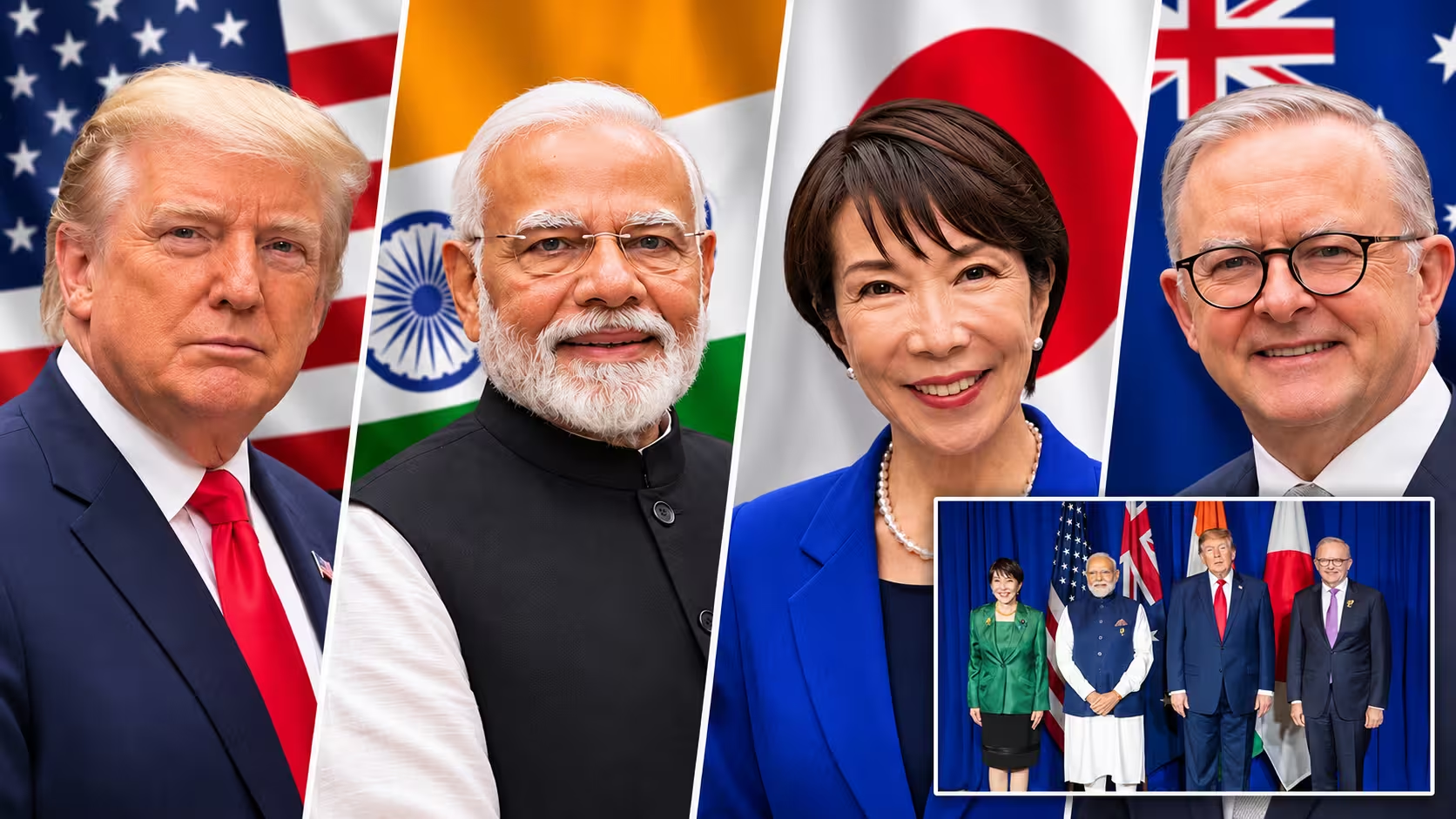
19 November 2026 | Manila, Philippines | The leaders of the United States, India, Japan and Australia have met for their first QUAD leaders-level summit in more than two years, announcing new initiatives covering maritime security, critical minerals, artificial intelligence, cybersecurity and regional economic cooperation.
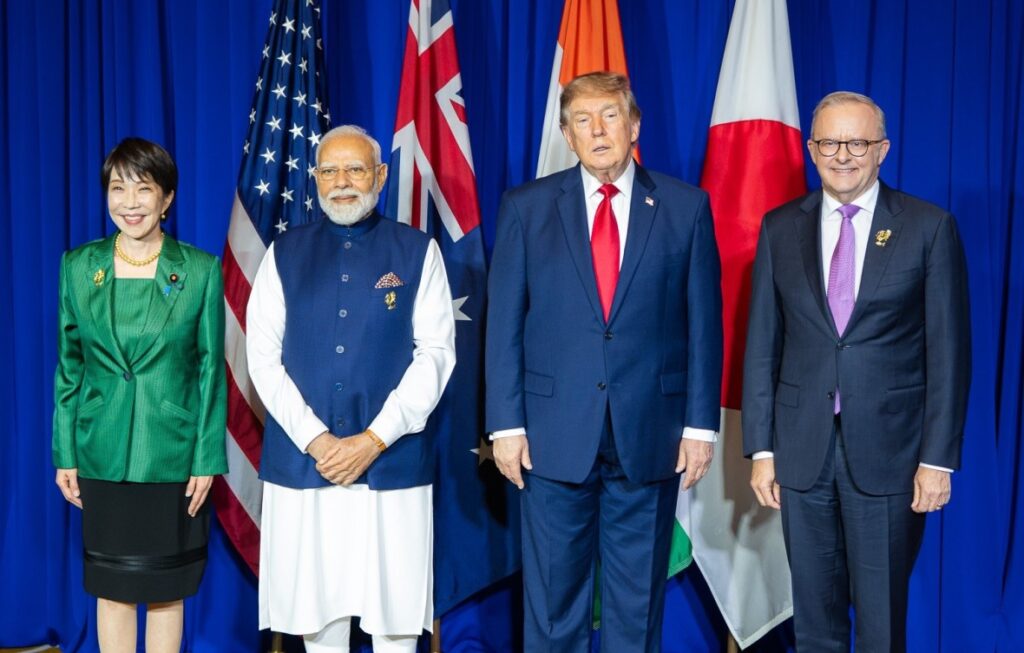
The summit took place in Manila on 17 November 2026, alongside ASEAN-related meetings, bringing together US President Donald Trump, Indian Prime Minister Narendra Modi, Japanese Prime Minister Sanae Takaichi and Australian Prime Minister Anthony Albanese.
Although the QUAD is frequently associated with security concerns in the Indo-Pacific, the latest meeting demonstrated the partnership’s wider ambitions, including business development, technological cooperation and stronger regional infrastructure.
The leaders also reiterated their opposition to coercive actions that could undermine regional stability, while reaffirming the importance of working with Southeast Asian countries.
But what exactly was agreed, what did each leader say, and what could these developments mean for countries beyond the four-member partnership?
Key Points from the 2026 QUAD Summit
- The four leaders met in Manila on 17 November, marking the return of leaders-level QUAD discussions after more than two years.
- A new QUAD Business Leaders’ Forum is scheduled for early 2027.
- The four countries plan their first QUAD maritime surveillance aircraft exercise in 2027.
- New cooperation was announced in cybersecurity, trusted artificial intelligence and connectivity infrastructure.
- Leaders expressed concern about economic coercion and restrictions affecting critical supply chains.
- The partnership reaffirmed its support for ASEAN and a free and open Indo-Pacific.
What Is the QUAD and Why Does It Matter?
The Quadrilateral Security Dialogue, commonly called the QUAD, is a strategic partnership involving four countries:
- United States
- India
- Japan
- Australia
The grouping originated in cooperation following the devastating 2004 Indian Ocean tsunami and subsequently developed into a platform for diplomatic and strategic coordination.
It was revived in 2017, with leaders-level meetings beginning in 2021.
Unlike NATO, the QUAD is not a collective defence alliance. Its members are not automatically obligated to defend one another in the event of an attack.
Instead, it operates through consultations and practical cooperation on regional security, technology, infrastructure, disaster response and economic resilience.
The Indo-Pacific encompasses major maritime routes connecting Asia with the Pacific and Indian Oceans. These routes are essential for international trade, energy shipments and global supply chains.
Developments affecting their security can therefore have consequences far beyond the four QUAD members.
What Did the Four Leaders Agree On in Manila?
1. New Maritime Surveillance Cooperation
One of the summit’s major announcements was the Indo-Pacific Maritime Surveillance Collaboration.
Under the initiative, the four countries intend to improve the sharing of maritime information and strengthen their ability to monitor activity across the region.
Their P-8 and P-3C maritime patrol aircraft are scheduled to participate in a joint QUAD-context exercise in 2027.
Such surveillance capabilities can support the monitoring of maritime movements and activities, including potentially unlawful activity at sea.
The announcement represents a further step in practical security coordination, although it does not create a formal collective defence obligation.
2. Critical Minerals and Supply Chain Security
The QUAD leaders also discussed growing concerns over the concentration of critical mineral production, processing and supply chains.
Critical minerals and rare earth elements are important inputs for electric vehicles, renewable energy technologies, electronics, defence equipment and advanced manufacturing.
Heavy dependence on a limited number of suppliers can expose businesses and governments to production interruptions, export restrictions or political disagreements.
The four countries committed to improving supply chain resilience and expressed concern over economic coercion, including arbitrary export restrictions.
For Australia, a major mineral-producing economy, cooperation in this area also presents potential investment and industrial opportunities.
However, the summit statement did not establish that all existing supply-chain vulnerabilities had been resolved.
3. Artificial Intelligence and Emerging Technologies
Artificial intelligence featured prominently in the discussions.
The leaders supported a previously announced technology accelerator designed to improve regional access to trusted advanced AI systems and provide technical assistance.
The initiative is intended to strengthen cooperation between participating countries and support wider technological development across the Indo-Pacific.
As AI becomes increasingly important to manufacturing, logistics, government services and digital infrastructure, the reliability and security of technology supply chains are becoming significant economic concerns.
The initiative also reflects efforts by countries to develop technology partnerships without relying exclusively on a small number of international suppliers.
4. Cybersecurity and Undersea Connectivity
The four countries announced enhanced cybersecurity cooperation in response to the increasing frequency and scale of cyber incidents affecting the region.
They also welcomed further progress under the QUAD Partnership for Cable Connectivity and Resilience.
Australia’s contribution is being expanded beyond data cables to include electricity cables, supporting regional connectivity and energy security.
Undersea communications cables are vital to international internet traffic, banking networks and digital services.
Improving the resilience of these systems could help reduce the risks associated with cable damage, network disruptions and infrastructure vulnerabilities.
5. Business Leaders’ Forum Planned for 2027
The leaders announced the inaugural QUAD Business Leaders’ Forum, scheduled for early 2027.
The forum is intended to bring together private-sector representatives, policymakers and experts from the four countries.
Its objectives include expanding commercial partnerships and exploring opportunities in strategic industries.
This development highlights the QUAD’s intention to expand cooperation beyond government-to-government discussions.
For businesses, the forum could provide opportunities to develop relationships in areas such as critical minerals, emerging technologies, infrastructure and regional services.
The commercial outcomes, however, will depend on the agreements and investments that follow.
What Did the Four QUAD Leaders Say?
The remarks made by the four leaders reflected a shared commitment to the partnership, although each highlighted different priorities.
Donald Trump: Security, Strength and Strategic Cooperation
US President Donald Trump described the QUAD as an increasingly important partnership and spoke about the value of cooperation between its four members.
He emphasised security and the importance of working together to preserve stability in the Indo-Pacific.
Trump also highlighted the significance of maritime cooperation and the planned joint surveillance exercise.
His comments placed particular emphasis on strengthening the partnership’s practical security activities and maintaining relationships with the other leaders.
The meeting was also significant because it marked the first QUAD leaders’ summit since Trump’s return to the White House.
Narendra Modi: A Constructive and Trusted Partnership
Indian Prime Minister Narendra Modi described the QUAD as a “constructive and trusted partnership”.
He emphasised the importance of translating discussions into practical outcomes that benefit the Indo-Pacific.
Modi also referred to the continued engagement between the four countries’ foreign ministers as evidence of their commitment to cooperation.
India’s approach reflects the importance it places on maritime security, resilient supply chains, technology partnerships and regional stability.
For New Delhi, the QUAD also provides a diplomatic platform through which India can strengthen cooperation with other major Indo-Pacific economies.
Sanae Takaichi: A Free and Open Indo-Pacific
Japanese Prime Minister Sanae Takaichi emphasised the importance of protecting regional peace and stability while strengthening the ability of countries to make their own decisions.
According to Japan’s Ministry of Foreign Affairs, she highlighted cooperation in maritime security, economic resilience, energy security and emerging technologies.
Takaichi also reaffirmed Japan’s commitment to the vision of a Free and Open Indo-Pacific.
She stressed the importance of producing practical results that benefit countries throughout the region, rather than limiting the partnership to strategic declarations.
Japan additionally raised concerns relating to North Korea, cybersecurity and wider regional security developments.
Anthony Albanese: Economic Opportunity Alongside Security
Australian Prime Minister Anthony Albanese emphasised that the partnership represented more than the individual contributions of its four members.
He highlighted critical minerals, artificial intelligence, maritime security and private-sector involvement as important areas for future cooperation.
Albanese said the QUAD countries represented a combined GDP of nearly US$35 trillion and almost one-fifth of global trade.
He also welcomed the planned business forum and the expansion of Australia’s cable connectivity work.
Speaking to journalists following the meeting, Albanese explained that maritime surveillance was not limited to military concerns and could also address problems such as illegal fishing.
His remarks highlighted Australia’s interest in combining regional security cooperation with trade, investment and economic resilience.
Is the QUAD Directed Against China?
China remains an important part of the wider geopolitical discussion surrounding the QUAD.
The four countries share concerns about activities that could undermine regional stability, particularly in strategically important maritime areas.
The summit’s joint statement opposed attempts to alter the status quo through force or coercion and expressed concern about economic pressure through export restrictions.
Japan’s official account confirmed that leaders discussed the East China Sea and South China Sea.
However, the QUAD’s public agenda also includes commercial cooperation, technology, infrastructure, disaster response and cybersecurity.
China has previously criticised the QUAD framework, viewing aspects of its security cooperation as part of wider strategic competition in the region.
The QUAD countries, meanwhile, present their partnership as supporting stability, sovereignty and a rules-based regional environment.
When asked about possible objections from China, Albanese stressed that Australia sought to cooperate with China where possible while protecting its national interests.
These different perspectives illustrate the diplomatic challenges surrounding security cooperation in the Indo-Pacific.
Why Did the QUAD Leaders Meet During the ASEAN Summit?
The decision to convene the QUAD meeting in Manila was significant.
Southeast Asia lies at the centre of several major trade routes and is an important region for infrastructure investment, economic development and maritime security.
All four QUAD members maintain extensive diplomatic or economic relationships with ASEAN countries.
Meeting alongside ASEAN-related events provided an opportunity to reaffirm engagement with Southeast Asian partners.
The joint statement explicitly supported ASEAN centrality and unity, meaning that the QUAD recognises ASEAN’s important role in regional diplomatic cooperation.
This matters because Southeast Asian countries maintain diverse relationships with major powers and generally seek to preserve room for independent diplomatic and economic decisions.
What Does the QUAD Summit Mean for New Zealand and the Wider World?
New Zealand is not a member of the QUAD, but developments involving its members and the wider Indo-Pacific can still affect the country.
Australia is one of New Zealand’s closest economic and security partners, while the United States, Japan and India are important participants in regional trade and diplomatic relations.
Greater regional cooperation could have indirect implications in several areas.
Trade and supply chains: Changes in critical mineral supply, shipping routes and infrastructure investment can influence costs and availability for businesses across the region.
Maritime security: New Zealand depends heavily on international shipping connections for imports and exports. Regional maritime stability therefore has economic importance.
Technology and cybersecurity: Greater cooperation on digital infrastructure, communications cables and trusted technology could influence the wider environment in which New Zealand businesses operate.
Regional diplomacy: New Zealand maintains close relations with Pacific Island countries and ASEAN partners, making developments in the wider Indo-Pacific relevant to its foreign policy interests.
However, the initiatives announced by the QUAD do not automatically extend to New Zealand. Any direct participation or economic benefits would depend on future arrangements and decisions.
What Happens Next for the QUAD?
The next major steps include preparations for the inaugural business forum in early 2027, the planned maritime surveillance exercise, and further implementation of cooperation involving cybersecurity, AI and infrastructure.
The QUAD’s effectiveness will depend not only on its leaders’ declarations but also on whether these initiatives produce measurable outcomes.
Questions remain about funding, implementation timelines, participation by regional partners and the long-term sustainability of various programmes.
The Manila summit nevertheless established a renewed programme of leaders-level cooperation following a gap of more than two years.
For the wider Indo-Pacific, the coming year will help demonstrate how the QUAD’s diplomatic commitments translate into activities affecting businesses, technology, maritime security and regional relationships.
Editorial Note
This article is based on the official QUAD Leaders’ Summit joint statement issued on 17 November 2026, government accounts of the meeting, published leaders’ remarks and contemporary news reporting available as of 19 November 2026. Announced initiatives and proposed future activities should not be interpreted as already completed. The article is intended for general news and educational purposes.
Official Sources and Further Reading
- QUAD Leaders’ Summit Joint Press Release – Australian Prime Minister
- QUAD Leaders’ Summit – Japanese Ministry of Foreign Affairs
- Anthony Albanese’s Opening Remarks – 17 November 2026
- Anthony Albanese’s Media Remarks – 18 November 2026
- White House Video – QUAD Leaders’ Meeting
- Australian Government – 2026 QUAD Summit