

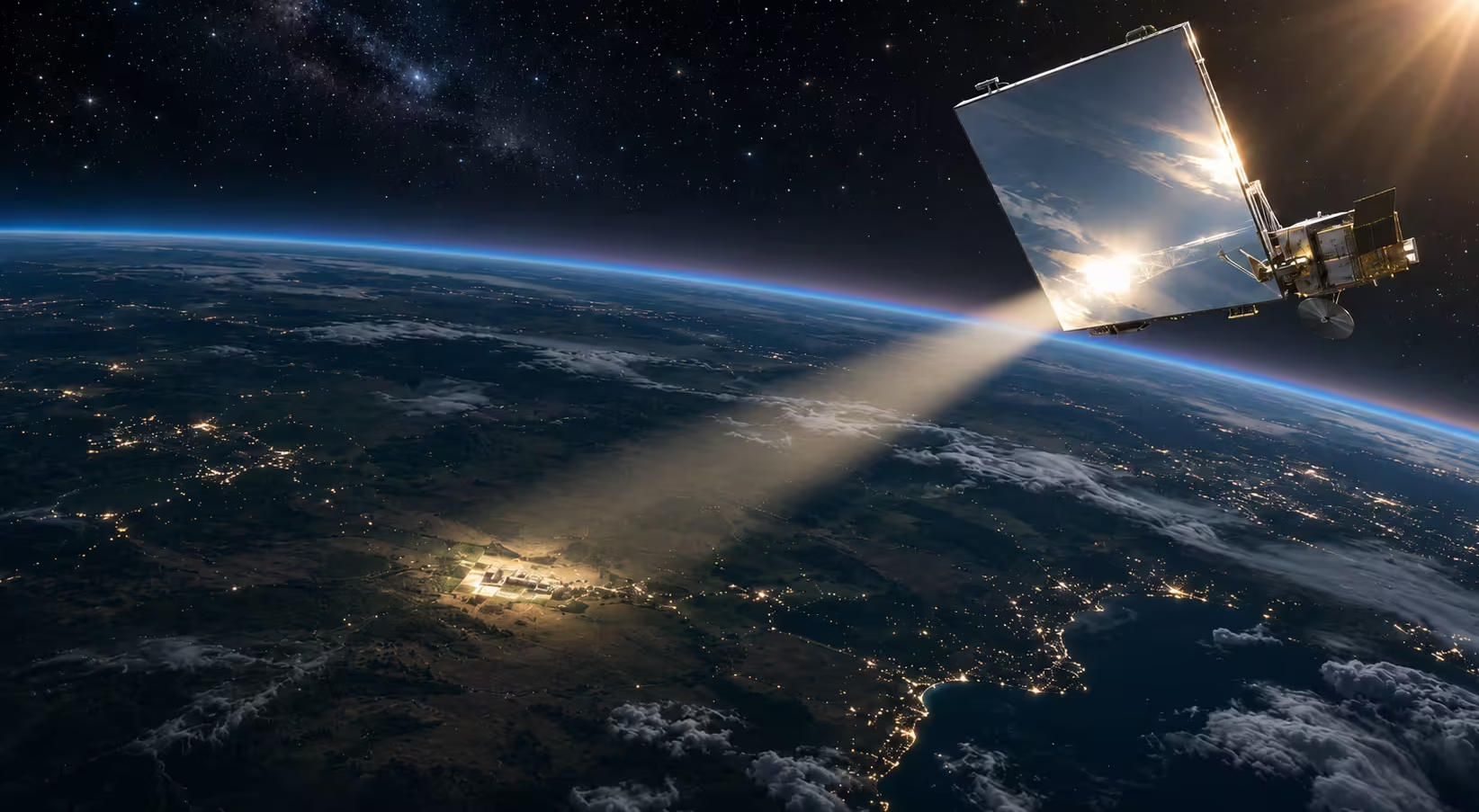
11th November | Imagine ordering sunlight after sunset, illuminating a remote construction site, helping rescuers search for missing people or even allowing solar farms to generate electricity after dark. An American space technology company wants to make this possible using giant mirrors orbiting Earth.
A Company Wants to Sell Sunlight at Night But Can It Really Work?
For thousands of years, humans have organized their lives around one unavoidable natural cycle: the Sun rises, daylight arrives, the Sun sets and darkness follows.
But what if that cycle could be changed at least temporarily, in selected locations?
California-based technology startup Reflect Orbital is developing an ambitious system to redirect sunlight from space towards Earth during nighttime hours.
Rather than producing artificial light or generating electricity in space, the company’s proposed technology would use enormous reflective mirrors mounted on satellites orbiting our planet.
The idea is simple to describe, although extraordinarily challenging to achieve: capture sunlight that is still reaching a satellite in space and reflect it towards a location on Earth where the Sun has already set.
The company envisions selling this redirected sunlight as an on-demand commercial service.
However, the project is still in development, and its potential consequences for astronomy, wildlife and the natural night sky are already attracting international attention.
How Can a Satellite Deliver Sunlight at Night?
Although one part of Earth experiences darkness, satellites orbiting the planet may still have a direct view of the Sun.
Reflect Orbital plans to take advantage of this difference using large, adjustable mirrors.
The proposed system would work through several stages:
- A satellite equipped with a reflective surface orbits Earth.
- While the satellite is illuminated by the Sun, its mirror is positioned to redirect sunlight towards a selected ground location.
- The reflected light travels through Earth’s atmosphere and illuminates part of the target area.
- As the satellite moves, its orientation would be adjusted to control where the light falls.
In theory, a network of satellites could coordinate their reflections to provide illumination for longer periods.
According to the Reflect Orbital website, the company envisages adjustable light intensity, geographically targeted coverage and service requests through a website or application.
Importantly, this would not create a second Sun or illuminate the entire dark side of Earth. The concept involves directing sunlight towards specific locations for limited periods.
What Would People Actually Buy Sunlight For?
The most interesting part of Reflect Orbital’s proposal is its potential commercial use.
The company is considering several applications that could make redirected sunlight valuable.
-
Solar Farms Generating Electricity After Sunset
Solar energy has one obvious limitation: traditional photovoltaic panels need sufficient light to produce useful electricity.
Reflect Orbital wants to investigate whether reflected sunlight could extend electricity generation into evening hours.
If technically and commercially successful, this could provide another option for certain solar power operations.
However, whether orbital mirrors can deliver enough energy at a competitive cost remains uncertain. The company has not yet demonstrated a commercially viable nighttime solar generation service.
-
Emergency Rescue Operations
Imagine a major earthquake striking a remote region after sunset.
Emergency responders may need large amounts of lighting to search damaged buildings, examine hazardous terrain or locate survivors.
Reflect Orbital proposes that its satellites could illuminate selected disaster zones without requiring extensive temporary lighting infrastructure.
Such applications would depend on satellite availability, targeting accuracy, adequate brightness and approval to operate.
-
Construction, Mining and Industrial Work
Large industrial sites often depend on powerful artificial lighting for nighttime operations.
The company suggests that redirected sunlight could support activities such as construction, mining and remote industrial work.
Whether the service could replace conventional lighting would depend on its intensity, reliability, coverage and cost.
-
Agriculture and Public Spaces
Reflect Orbital is also exploring possible applications in agriculture, urban lighting and special events.
These ideas are more speculative and would require careful assessment of environmental effects, particularly where additional nighttime illumination could interfere with normal biological cycles.
How Bright Would This Artificially Extended Daylight Be?
One of the biggest misunderstandings about the project is that its first satellite could instantly turn night into a bright afternoon.
That is not what the company’s initial demonstration proposes.
Reflect Orbital’s published development roadmap describes an early lighting target of approximately 0.1 lux for five minutes, comparable to the illumination of a full Moon.
Its longer-term ambitions are considerably greater.
| Development target | Proposed capability |
| Initial demonstration | Moonlight-like illumination for around five minutes |
| 2027 | Approximately 2 lux for extended periods |
| 2028 | Up to 100 lux for selected applications |
| 2030 | Up to 5,000 lux for short periods |
| 2035 | Up to 36,000 lux for hours in some proposed scenarios |
These figures represent Reflect Orbital’s development targets, not independently demonstrated operational performance. Future results and deployment schedules remain uncertain.
The company has also outlined an ambitious satellite network potentially reaching more than 50,000 spacecraft by 2035.
Such a large constellation would present substantial engineering, financial, regulatory and environmental challenges.
Sunlight has always been free, and darkness has always been part of nature. If technology allows companies to deliver daylight after sunset, who should have the final say the company, the customer, the government or the people living beneath it?
Has Reflect Orbital Actually Launched Its Space Mirrors?
As of 11 November 2026, Reflect Orbital has not publicly demonstrated its orbital sunlight-delivery service.
In July 2026, the United States Federal Communications Commission authorized its proposed Eärendil-1 demonstration satellite, which is designed to carry a large deployable reflector.
However, the company’s development plans have continued to evolve.
On 30 October 2026, Reflect Orbital announced that it had filed an application for another developmental satellite called Eärendil-0, with a launch proposed no earlier than April 2027.
Unlike the planned reflector-equipped satellite, Eärendil-0 will not carry an orbital mirror.
Instead, it is intended to test essential spacecraft communications and control systems before the company attempts its more ambitious sunlight-reflection demonstration.
The development highlights the difference between a compelling technological concept and a fully operational commercial service.
Source: Reflect Orbital – Eärendil-0: Testing the Foundations First
India Becomes Part of the Sunlight-from-Space Project
The venture also has an international dimension.
On 14 October 2026, Reflect Orbital announced an agreement with Indian private space company Skyroot Aerospace for two dedicated satellite launches.
The agreement includes the planned use of Skyroot’s Vikram-1 rocket and its developing Vikram-1U launch vehicle.
This partnership connects an American satellite technology project with India’s expanding commercial space industry.
It also raises questions about how countries may eventually regulate satellites that deliver light across national borders.
Source: Reflect Orbital – Two Skyroot Launches
But Should Companies Be Allowed to Change the Night Sky?
While the potential benefits are intriguing, not everyone welcomes the prospect of commercial sunlight after dark.
Astronomers, environmental organizations and researchers have expressed concerns about how reflected sunlight could affect the natural nighttime environment.
Their concerns include:
- Astronomy: Additional brightness and reflections could interfere with observations of faint celestial objects.
- Wildlife: Many animals depend on natural patterns of daylight and darkness for feeding, migration and reproduction.
- Human communities: Additional nighttime illumination could affect people living near targeted locations, including those who never requested the service.
- Space congestion: A large constellation would add to the growing number of spacecraft operating in low-Earth orbit.
A scientific analysis discussed by Macquarie University in October 2026 also raised concerns about atmospheric scattering. Even if reflected sunlight is directed at a particular location, some light could scatter through the surrounding atmosphere, potentially brightening areas beyond the intended target.
Reflect Orbital maintains that its services would require appropriate approvals and that it intends to work with regulators, scientists and local communities.
Nevertheless, there is an important unresolved question: Who should have the authority to decide when and where natural darkness is interrupted?
Source: Macquarie University – An American Startup Wants to Sell Sunlight After Dark
Can Anyone Really Own or Sell Sunlight?
Sunlight itself is a natural resource. Reflect Orbital is not claiming ownership of the Sun.
Its proposed commercial product is the technological service of redirecting sunlight to a particular location at a requested time.
In that sense, customers would be paying for satellite infrastructure, precision targeting, operations and access to additional illumination.
The concept resembles other businesses that charge for delivering or managing naturally available resources rather than creating those resources themselves.
However, a workable business will require more than the ability to reflect light.
The company must establish whether customers receive enough useful illumination to justify the cost of launching, operating and maintaining a satellite network.
It must also address reliability, safety, regulatory compliance and possible environmental impacts.
Could Sunlight Eventually Become an On-Demand Service?
Reflect Orbital’s proposal represents an unusual intersection of space engineering, renewable energy, commercial innovation and environmental policy.
The idea could create new opportunities for emergency response, industrial operations and selected energy applications if future demonstrations establish that the technology is practical.
But major uncertainties remain.
The first priority is proving that satellites can consistently and precisely deliver useful light from orbit.
The next challenge is demonstrating that the benefits outweigh the operating costs and potential effects on the natural nighttime environment.
For now, the world’s familiar pattern of daylight and darkness remains unchanged.
Yet the project introduces a question that may become increasingly relevant as commercial space technology advances:
If humanity develops the ability to deliver sunlight after sunset, should darkness become something we can choose to switch off?
What Questions Come to Mind After Reading About Sunlight at Night?
Can we really buy sunlight in the future?
Would ordinary households eventually be able to order extra sunlight, just as we pay for electricity or internet services?
How much would five minutes or one hour of sunlight cost?
Would this technology be affordable for ordinary people, or only for governments, industries and wealthy customers?
Could someone switch on sunlight above my house without my permission?
Who would control where reflected sunlight falls, and would residents have the right to refuse it?
Would extra sunlight disturb our sleep, wildlife and the environment?
What happens to humans, birds, insects and other animals if natural darkness is interrupted?
Could countries use giant space mirrors as weapons or for surveillance?
Could this technology be misused to interfere with other countries, and what international rules would prevent that?
Could sunlight from space replace streetlights or help solar panels work at night?
Would orbital sunlight actually be practical, economical and environmentally beneficial compared with existing technologies?
What happens if thousands of these satellites fill the sky?
Would we still see stars clearly, and could additional satellites create more space debris or interfere with astronomy?
If companies can sell sunlight, what other natural resources might become commercial services?
Could future technologies allow businesses to control access to other aspects of our natural environment, and who should regulate them?
Editorial note: This article examines an emerging space technology project using publicly available company announcements and independent reporting. The projected lighting performance, satellite numbers and commercial applications are development goals, not proof of an operational service.
Who Controls the Satellites Orbiting Earth? Countries, Companies and Global Rules Explained
Nuclear Energy vs Nuclear Weapons: Understanding the Science Behind Both
What Is ALPS-Treated Water? Understanding Nuclear Wastewater Treatment and International Oversight