
November 2026 : Every year, international organizations publish employment and unemployment statistics that influence government policies, business decisions and our understanding of the global economy.
In our previous article, Global Data Shows Unemployment Has Fallen Over the Past Decade. So Why Are We Worried About Losing Our Jobs?, we explored employment trends, artificial intelligence and concerns about future job security.
But how do international organisations actually know how many people are employed or unemployed around the world?
Who collects this information? Are countries legally required to provide it? And what happens when official national data is unavailable?
Key points
- National statistical agencies collect official employment and unemployment information.
- The International Labour Organization (ILO) develops international statistical standards and produces global employment estimates.
- International conventions and national legislation establish different statistical obligations.
- Countries use representative household surveys rather than interviewing every citizen.
- Missing national data may be estimated using statistical models.
- Unemployment can fall even without the creation of new jobs.
1. Who collects global employment and unemployment data?
Employment statistics primarily originate from national statistical agencies responsible for collecting, processing and publishing official labour market information.
Examples of national statistical agencies
| Country | Responsible statistical organisation |
|---|---|
| Australia | Australian Bureau of Statistics (ABS) |
| Brazil | Brazilian Institute of Geography and Statistics (IBGE) |
| China | National Bureau of Statistics (NBS) |
| Germany | Federal Statistical Office (Destatis) |
| India | National Statistics Office (NSO), Ministry of Statistics and Programme Implementation (MoSPI) |
| New Zealand | Stats NZ |
| Singapore | Ministry of Manpower (MOM) – Manpower Research and Statistics Department |
| United Kingdom | Office for National Statistics (ONS) |
| United States | Bureau of Labor Statistics (BLS) and US Census Bureau |
Countries are listed in alphabetical order.
These organisations collect information through household surveys, business surveys, population censuses and administrative records.
The International Labour Organization (ILO) then obtains national statistics and, where available, underlying survey data to produce internationally comparable employment estimates.
What role do international organisations play?
| Organisation | Primary responsibility |
|---|---|
| ILO | Labour statistical standards and global employment estimates |
| World Bank | Publishes development indicators, including ILO-modelled unemployment statistics |
| IMF | Economic analysis and forecasting |
| OECD | Labour market statistics, research and policy analysis |
| Eurostat | Comparable European employment statistics |
| UN Statistics Division | International statistical standards and coordination |
Interestingly, the World Bank’s modelled global unemployment indicator uses ILO estimates. Therefore, figures published by these two organisations are not necessarily independent measurements.
2. Are countries legally required to provide employment statistics?
There is no single universal law requiring every country to collect and submit identical employment statistics. However, several international and national frameworks establish statistical responsibilities.
ILO Labour Statistics Convention, 1985 (No. 160)
Countries that ratify this convention undertake obligations to regularly collect, compile and publish labour statistics according to the provisions they accept.
| Article | Main provision |
|---|---|
| Article 1 | Collection and publication of labour statistics |
| Article 2 | Consideration of international statistical standards |
| Article 4 | Protection of confidential information |
| Article 5 | Communication of published statistics to the ILO |
| Article 6 | Documentation of statistical methods and definitions |
| Article 7 | Employment, unemployment and labour force statistics |
| Article 16 | Statistical obligations accepted upon ratification |
ILO membership alone does not mean that a country has ratified Convention No. 160.
International statistical standards
The International Conference of Labour Statisticians (ICLS) develops internationally recognised definitions and methodologies. These standards improve comparability but are not automatically legally binding treaties.
National and regional legislation
Countries also operate under their own statistical legislation. For example, New Zealand has the Data and Statistics Act 2022, while European Union countries have additional statistical reporting obligations under EU regulations.
3. How do countries collect employment information?
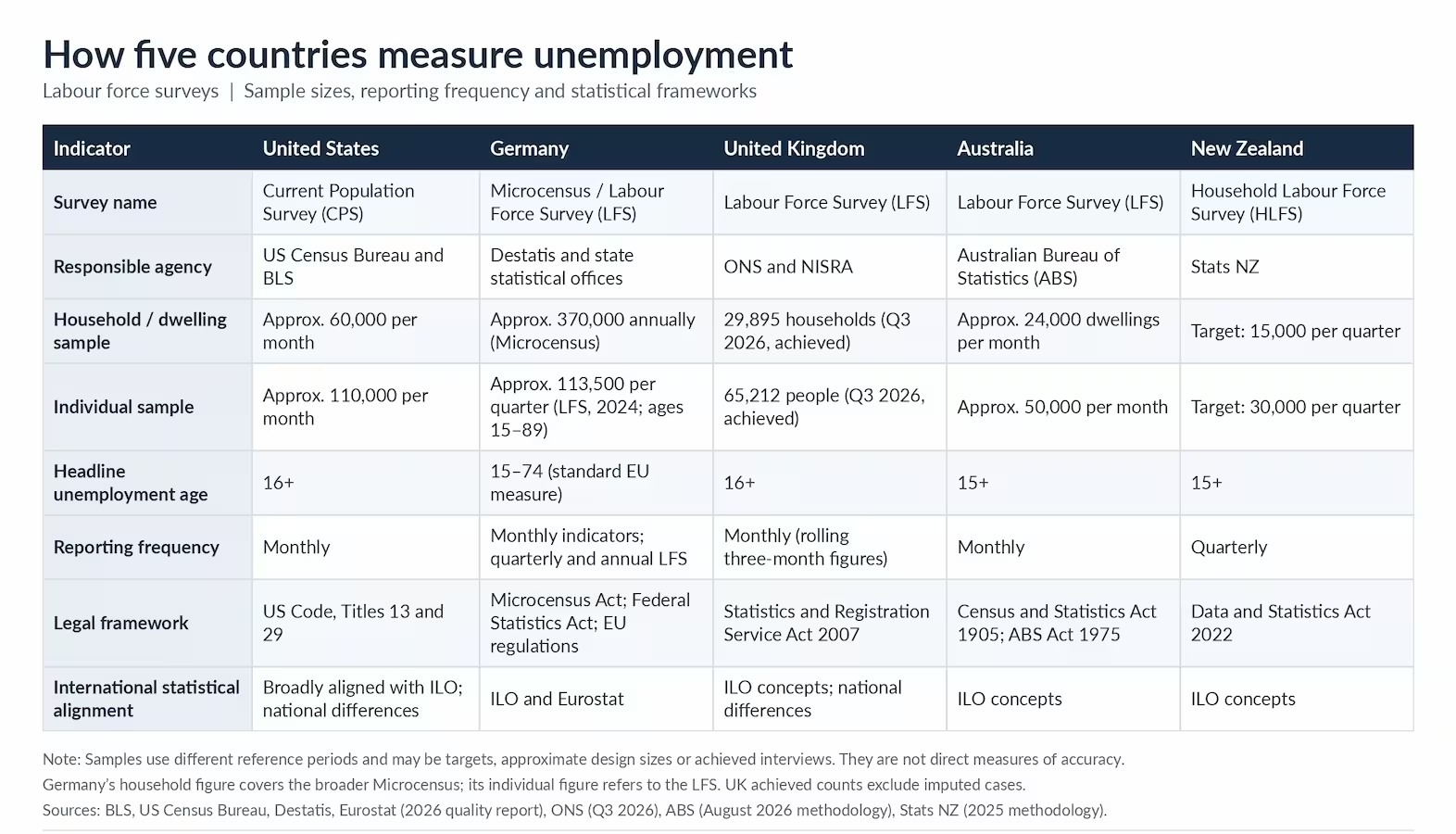
Most national statistical agencies use household labour force surveys to determine whether individuals are working, looking for employment or outside the labour force.
Selected households may be contacted through telephone interviews, face-to-face interviews or online questionnaires.
Typical survey questions include:
- Did you undertake any paid work last week?
- How many hours did you work?
- Do you have a job from which you were temporarily absent?
- Have you recently looked for employment?
- Are you available to start work?
- Would you like to work additional hours?
- What is your occupation and industry?
The collected information undergoes validation, statistical classification, weighting, estimation and quality checks before official figures are published.
Illustrative Comparison of employment data collection across five countries
4. Who is officially considered employed or unemployed?
International labour statistics generally divide the working-age population into three categories.
| Classification | Meaning |
|---|---|
| Employed | People undertaking qualifying work for pay or profit, including certain people temporarily absent from work |
| Unemployed | People without employment who are actively seeking and available for work, subject to specified exceptions |
| Outside the labour force | People who are neither employed nor meet the unemployment criteria |
Interestingly, under international statistical standards, someone working for as little as one hour for pay or profit during the reference week may be classified as employed.
Similarly, someone without a job who has stopped actively searching for employment may no longer be statistically classified as unemployed.
Receiving unemployment benefits is not a requirement for being classified as unemployed.
Being employed does not necessarily mean having a full-time, secure or well-paid job.
ILOSTAT – Labour Force Statistics and Definitions
5. How can interviewing a few thousand people represent an entire country?
Statistical agencies use scientifically designed sampling and weighting methods to estimate the characteristics of a larger population without interviewing every individual.
Imagine a hypothetical town with 10,000 working-age residents, where 500 individuals are selected for an employment survey.
| Employment status | Surveyed individuals | Estimated population |
|---|---|---|
| Employed | 350 | 7,000 |
| Unemployed | 25 | 500 |
| Outside the labour force | 125 | 2,500 |
| Total | 500 | 10,000 |
This is a simplified example assuming equal statistical weights, where each surveyed individual represents 20 people in the wider population.
The labour force consists of employed and unemployed people combined. The unemployment rate is calculated by dividing the number of unemployed people by the total labour force and multiplying by 100.
In this example:
- Working-age population: 10,000 people
- Employed: 7,000 people
- Unemployed: 500 people
- Total labour force: 7,500 people
- Unemployment rate: 6.67%
- Employment rate: 70%
- Labour force participation rate: 75%
In reality, statistical sampling and weighting are considerably more sophisticated. Statistical agencies account for selection probabilities, survey non-response, geographical distribution and population characteristics to improve the representativeness of their estimates.
This is how statistical agencies can estimate national employment and unemployment figures without interviewing every citizen.
US Bureau of Labor Statistics – Current Population Survey: Calculation and Estimation Methods | Australian Bureau of Statistics – Labour Force Survey Methodology | UK Office for National Statistics – Labour Force Survey Quality and Methodology
6. What happens when countries do not provide reliable employment data?
Not every country has the resources or infrastructure to conduct regular labour force surveys. Political instability, armed conflicts, limited funding and large informal economies can make collecting reliable information more challenging.
The ILO addresses these gaps through its ILO Modelled Estimates (ILOEST) system.
It uses available national statistics, historical information, United Nations population estimates and economic indicators from organisations such as the IMF and World Bank to estimate missing observations.
Availability of nationally reported unemployment data since 2017
| Region | Approximate labour force coverage |
|---|---|
| Global | 67.5% |
| Asia and the Pacific | More than 67% |
| Arab States | Around 48% |
| Africa | Around 15% |
The ILO describes historical reporting coverage in the Americas and Europe and Central Asia as almost complete.
These percentages describe the availability of nationally reported observations across a historical period. They do not indicate the proportion of individuals directly interviewed or the exact proportion of the latest global unemployment figure that is estimated.
The global unemployment rate is then calculated using the combined estimated labour force and unemployed population, rather than simply averaging individual countries’ unemployment rates.
Countries with larger labour forces consequently have a greater influence on the global figure.
7. Can unemployment fall without creating a single new job?
Yes. Consider the same hypothetical town with 10,000 working-age residents.
Suppose 300 unemployed people become discouraged and stop actively looking for employment.
| Employment indicator | Before | After |
|---|---|---|
| Employed | 7,000 | 7,000 |
| Unemployed | 500 | 200 |
| Outside the labour force | 2,500 | 2,800 |
| Total labour force | 7,500 | 7,200 |
| Unemployment rate | 6.67% | 2.78% |
| Employment rate | 70% | 70% |
| Labour force participation | 75% | 72% |
| New jobs created | — | 0 |
Hypothetical example for educational purposes.
Although unemployment has fallen considerably, not a single additional job has been created.
The number of employed people remains unchanged. The difference is that 300 individuals no longer meet the statistical definition of unemployment.
This does not mean that the historical decline in global unemployment occurred for this reason. However, it demonstrates why unemployment figures must be considered alongside other employment indicators.
8. Can we trust global unemployment statistics?
Internationally recognised statistical standards, scientific sampling, quality checks and professional independence help protect the reliability of official statistics.
The United Nations Fundamental Principles of Official Statistics also emphasise impartiality, transparency, scientific methods and confidentiality.
However, no statistical system is entirely immune to errors, methodological differences, inadequate resources or political interference.
The ILO assesses the sources, coverage and consistency of national information, but it does not independently verify every household interview conducted worldwide.
Historical figures may also be revised when new national information becomes available or statistical methods are improved.
As artificial intelligence and automation continue to transform employment, it may become increasingly important to examine additional indicators.
| Indicator | What it reveals |
|---|---|
| Employment rate | Proportion of the working-age population employed |
| Labour force participation | People working or participating in the labour market |
| Underemployment | Unmet need for additional working hours |
| Real wage growth | Changes in purchasing power |
| Job vacancies | Demand for workers |
| Informal employment | Employment outside certain formal arrangements |
| Job quality | Earnings, working conditions and security |
| Labour productivity | Economic output relative to labour input |
| Household income | Financial circumstances of individuals and families |
Understanding the numbers behind unemployment
Global unemployment statistics are not produced by counting every employed or unemployed person worldwide.
They are the result of national surveys, internationally recognized definitions, statistical weighting, quality checks and economic modelling.
Although these figures provide valuable insights into the global economy, they cannot independently tell us whether people have secure jobs, adequate incomes or sufficient employment opportunities.
As AI, automation and autonomous technologies change the way businesses operate, understanding the relationship between employment, productivity, income and labour force participation may become even more important.
Perhaps the question we should ask is not simply whether unemployment is rising or falling, but whether people are finding meaningful, secure and adequately paid employment.
Frequently Asked Questions About Global Employment Statistics
1. Why is someone working only one hour a week classified as employed?
International labour statistical standards generally classify someone as employed if they work for at least one hour for pay or profit during the reference week. This helps capture part-time, casual and informal employment, but does not necessarily indicate adequate income or job security.
2. Can governments influence official unemployment statistics?
International statistical standards and national legislation aim to protect professional independence and statistical integrity. However, political interference, methodological changes and weaknesses in national statistical systems can affect the reliability of reported figures.
3. How accurate are employment estimates for countries with limited statistical information?
The ILO uses available historical data, demographic information and economic indicators to estimate missing employment statistics. These estimates are useful but generally carry greater uncertainty when reliable national information is limited.
4. Can unemployment decline while the actual number of employed people also falls?
Yes. If enough people stop actively seeking employment and move outside the labour force, the unemployment rate can decline even when fewer people are employed. This is why employment rates and labour force participation should also be examined.
5. Will existing employment indicators remain adequate in the age of autonomous AI agents?
Traditional employment indicators will remain useful, but additional attention may need to be given to working hours, household income, job quality, productivity and the distribution of economic benefits as AI and automation become more advanced.
ILO – Labour Force Statistics | ILO – Modelled Estimates Methodology | United Nations – Fundamental Principles of Official Statistics
Related article
Editorial Note : This article is intended for informational and educational purposes only and is based on publicly available information from sources including the International Labour Organization (ILO), United Nations, World Bank, and national statistical agencies. It provides analytical insights and does not constitute financial, legal, political, or professional advice. Statistical methodologies, legal obligations, employment estimates, and other data may vary between countries and may change over time. Any hypothetical examples are included solely to explain concepts and should not be interpreted as actual employment data, economic forecasts, or predictions. Readers are encouraged to consult official sources and qualified experts for verified guidance and advice relevant to their specific circumstances.