
November 2026 : Despite technological advancements, automation and widespread concerns about AI-driven job losses, global unemployment remains below levels recorded a decade ago. But do the numbers tell us the whole story?
In other words, a greater proportion of the global labour force is employed today than a decade ago, despite significant technological advancements, automation and economic disruptions.
Across the world, discussions about artificial intelligence (AI), automation, corporate restructuring and job losses have become increasingly common. Employees are questioning the security of their professions, graduates are wondering whether their qualifications will remain relevant, and businesses are reconsidering how much of their work requires human involvement.
Yet global employment statistics present a seemingly different picture.
Historical unemployment estimates published through the World Bank show that global unemployment has declined considerably compared with a decade ago. Meanwhile, the International Labour Organization’s (ILO) Employment and Social Trends 2026 report projects that global unemployment will remain relatively stable at around 4.9% in 2026.
This raises an important question: if global unemployment is considerably lower than it was ten years ago, why are people concerned about losing their jobs?
The answer may lie in the difference between the number of jobs available, the quality of those jobs, the skills required to perform them and the security they offer.
Furthermore, historical employment data tells us what has already happened. It does not necessarily tell us what will happen as artificial intelligence, autonomous systems and robotics become more capable.
Key points
- Global unemployment has declined from approximately 6% in 2015 to below 5% in 2025.
- The ILO projects global unemployment to remain around 4.9% in 2026.
- The World Economic Forum estimates that wider structural changes could create 170 million jobs and displace 92 million existing jobs by 2030.
- Approximately one in four workers worldwide holds an occupation with some potential exposure to generative AI.
- Low unemployment does not necessarily indicate secure employment, adequate salaries or good working conditions.
- Autonomous AI agents could introduce new challenges that historical employment statistics cannot yet fully capture.
- The future of employment will depend not only on technological progress but also on consumer demand, income distribution, education and government policies.
ILO Generative AI and Jobs (International Labour Organisation)
1.Is global unemployment really declining?
Over the past decade, the global labour market has experienced significant changes. Despite technological advancements, geopolitical tensions, economic uncertainty and the disruption caused by the COVID-19 pandemic, the estimated worldwide unemployment rate has declined considerably compared with 2015.
The pandemic temporarily reversed this progress in 2020, but unemployment subsequently declined as economies reopened and economic activity recovered.
Global unemployment: 2015-2026
| Year | Global unemployment rate | Data status |
|---|---|---|
| 2015 | 6.00% | Historical estimate |
| 2016 | 5.97% | Historical estimate |
| 2017 | 5.90% | Historical estimate |
| 2018 | 5.76% | Historical estimate |
| 2019 | 5.59% | Historical estimate |
| 2020 | 6.59% | Historical estimate |
| 2021 | 6.05% | Historical estimate |
| 2022 | 5.23% | Historical estimate |
| 2023 | 4.85% | Historical estimate |
| 2024 | 4.81% | Historical estimate |
| 2025 | 4.79% | Historical estimate |
| 2026 | 4.90% | ILO projection |
Data sources: World Bank – Unemployment, Total (% of Total Labour Force) | Historical World Unemployment Data – YCharts | ILO – Employment and Social Trends 2026
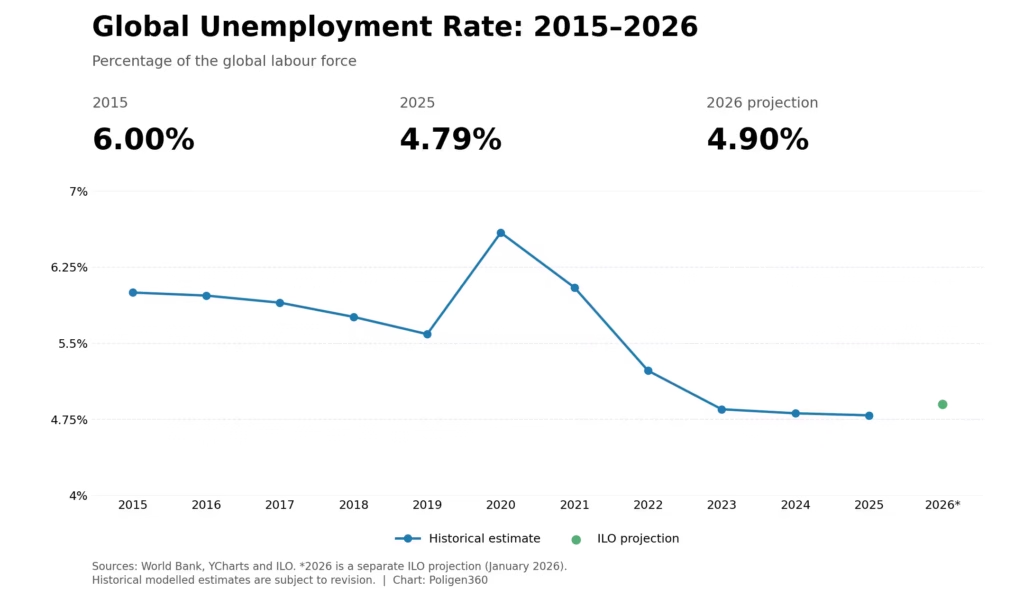
Note: Historical figures are based on modelled estimates and are subject to statistical revisions. The 2026 figure is a separate ILO projection published in January 2026, rather than a completed annual estimate.
What does the data reveal?
The long-term trend can be divided into four broad periods:
-
2015-2019 | Gradual decline: Global unemployment decreased from 6.00% to 5.59%, before the COVID-19 pandemic.
-
2020-2021 | Pandemic disruption: Global unemployment increased sharply to 6.59% in 2020 before declining to 6.05% in 2021.
-
2022-2025 | Post-pandemic recovery: Global unemployment continued to decline, reaching an estimated 4.79% in 2025.
-
2026 – Projected stability: The ILO projects global unemployment to remain relatively stable at approximately 4.9%, equivalent to around 186 million unemployed people worldwide.
Between 2015 and 2025, the estimated global unemployment rate declined by 1.21 percentage points, representing a relative reduction of approximately 20.2%.
The World Bank historical series and the ILO’s published report may differ slightly because of statistical revisions, estimation dates and rounding. However, both indicate that global unemployment remains considerably below levels recorded a decade earlier.
Although these figures demonstrate resilience in the global labour market, they do not mean that employment conditions have improved equally across countries, industries, age groups or income levels.
Furthermore, declining historical unemployment rates do not necessarily guarantee future employment security, particularly as artificial intelligence, automation and increasingly autonomous technologies reshape the way businesses operate.
This brings us back to the fundamental question: if global unemployment has fallen over the past decade, why are people increasingly concerned about losing their jobs?
2. How can unemployment fall while companies are cutting jobs?
One of the most common misunderstandings surrounding employment statistics is the assumption that job losses automatically result in fewer jobs across the entire economy.
In reality, businesses are constantly creating, eliminating and redesigning positions. While some industries reduce their workforce, others expand and recruit new employees.
The World Economic Forum’s Future of Jobs Report 2025, based on the perspectives of more than 1,000 employers across 55 economies, estimates that structural changes could create 170 million jobs and displace 92 million existing jobs between 2025 and 2030.
Projected global employment changes by 2030
| Employment indicator | Projected change |
|---|---|
| New jobs created | 170 million |
| Existing jobs displaced | 92 million |
| Net employment growth | 78 million |
These projections consider technological advancements, demographic developments, economic changes and environmental transitions. They should not be interpreted as the employment impact of AI alone or as guaranteed future outcomes.
How does this work in a real economy?
Consider a hypothetical economy experiencing the following employment changes:
| Industry | Employment change |
|---|---|
| Banking and administration | −20,000 |
| Traditional manufacturing | −15,000 |
| Retail | −10,000 |
| Healthcare | +25,000 |
| Renewable energy | +20,000 |
| Technology and infrastructure | +30,000 |
| Total jobs displaced | 45,000 |
| Total jobs created | 75,000 |
| Net employment growth | 30,000 |
Illustrative example only; these are not actual employment statistics.
Although this economy has gained 30,000 jobs overall, 45,000 existing positions have disappeared.
A person who loses a banking or administrative job may not automatically qualify for a newly created position in healthcare, renewable energy or engineering.
For that individual, improving national employment statistics may provide little immediate comfort.
An economy can create more jobs overall while simultaneously causing significant disruption to individual careers.
3. Does low unemployment necessarily mean people have good jobs?
Unemployment statistics provide an important but incomplete picture of the labour market.
A person who loses a permanent, well-paid position and subsequently finds lower-paid or part-time employment may no longer be classified as unemployed. However, that person’s financial situation, career prospects and standard of living may have deteriorated.
The headline unemployment rate does not directly measure whether people are earning enough, working their preferred number of hours or using their qualifications effectively.
The ILO’s Employment and Social Trends 2026 report identifies several significant challenges that remain despite relatively stable global unemployment.
Beyond the global unemployment rate
| Global employment indicator | Estimated or projected number |
|---|---|
| Unemployed people in 2026 | 186 million |
| People in the broader jobs gap in 2026 | 408 million |
| Workers in informal employment | 2.1 billion |
| Workers experiencing extreme working poverty | Nearly 300 million |
These categories can overlap and should not be added together.
The broader jobs gap includes people who want paid employment but cannot access it, including some who fall outside the conventional definition of unemployment.
Informal employment can also leave workers without adequate social protection, predictable earnings or basic employment rights.
Employment versus quality of employment
Consider two hypothetical employment situations:
| Employment condition | Previous job | New job |
|---|---|---|
| Annual income | $90,000 | $45,000 |
| Employment type | Permanent | Temporary |
| Working hours | Full-time | Part-time |
| Career progression | Established | Limited |
| Official employment status | Employed | Employed |
Although the individual’s circumstances have changed considerably, both situations are classified as employment.
This demonstrates why low unemployment does not necessarily mean that everyone is financially secure or satisfied with their employment situation.
The issue is not simply whether people have jobs. It is also whether those jobs provide sufficient income, stability, reasonable working conditions and opportunities for career development.
4. Is artificial intelligence taking jobs or changing them?
Artificial intelligence has become one of the central concerns in discussions about future employment.
However, an occupation being exposed to AI does not necessarily mean that the entire occupation will disappear.
Research published in 2025 by the International Labour Organization and Poland’s National Research Institute (NASK) found that approximately one in four workers globally holds an occupation with some degree of potential exposure to generative AI.
The researchers considered changes to existing occupations more likely than complete replacement in most cases because many work activities still require human input.
How AI could change existing professions
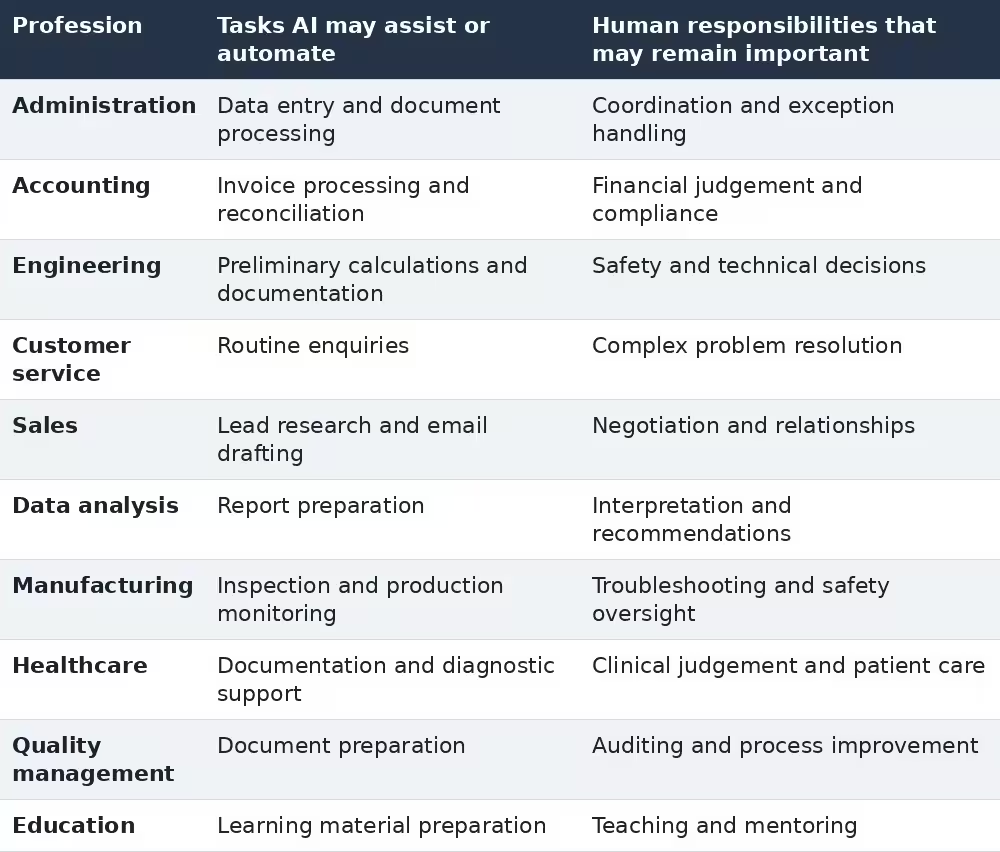
Illustrative examples of potential task redistribution. The extent of automation will vary depending on technological capabilities, regulations and business requirements.
A company may retain a particular profession while employing fewer people to perform the same volume of work. Alternatively, increased productivity may allow the company to expand and generate additional employment.
This makes the relationship between AI and employment more complicated than simply asking whether machines will replace humans.
5. If AI is not causing mass unemployment yet, why are people worried?
Concerns about AI are not entirely speculative. Businesses are already considering how artificial intelligence could reduce operating costs, increase productivity and change their workforce requirements.
According to the World Economic Forum’s Future of Jobs Report 2025, 41% of surveyed employers anticipate reducing their workforce where AI can automate certain activities. Meanwhile, 77% intend to train existing employees to work more effectively alongside AI.
These findings represent employer intentions rather than confirmed employment outcomes. Nevertheless, they help explain why workers are concerned about the future.
A subsequent ILO research review, published in June 2026, examined emerging evidence about the effects of generative AI on employment, productivity and work organization. The research indicates that evidence of widespread employment displacement remains limited, while the effects of AI adoption vary across workplaces.
Why historical employment data cannot guarantee future job security
The decline in unemployment between 2015 and 2025 does not prove that advanced AI systems will have no negative impact on employment in the coming decades.
Much of the historical improvement in employment occurred before the widespread adoption of today’s generative AI systems. Future technologies may also have capabilities that differ significantly from the tools available today.
The speed of technological development, the cost of implementing AI, its reliability and the ability of workers to transition into new occupations will all influence future employment outcomes.
Historical data provides a useful starting point, but it cannot settle the debate about future technological disruption.
6. Are companies eliminating jobs or simply reducing recruitment?
Job cuts are not always visible through major redundancy announcements. Businesses can also reduce their workforce gradually by changing their recruitment strategies.
For example, a company employing 100 people might experience the following changes over several years:
| Business decision | Workforce impact |
|---|---|
| Five employees retire | −5 |
| Five employees resign voluntarily | −5 |
| Technology reduces the need for replacements | No replacements |
| Business creates two specialist positions | +2 |
| Remaining workforce | 92 employees |
Illustrative example only.
In this scenario, the company’s workforce has declined without necessarily making any employees redundant.
However, eight potential employment opportunities have effectively disappeared compared with its original staffing level.
For graduates, unemployed workers and individuals looking to change careers, reduced recruitment can make the labour market feel considerably more challenging, even when there are relatively few formal redundancies.
OECD research published in 2026 identifies emerging difficulties among younger workers entering the labour market. It also cautions against attributing these challenges entirely to artificial intelligence, as economic conditions and longer-term employment trends contribute to the situation.
7. Which jobs are expected to grow, and which could decline?
The future of employment is not exclusively about artificial intelligence, software development or robotics.
Population growth, ageing societies, infrastructure development, environmental policies, energy requirements and changing consumer behaviour will also influence employment opportunities.
The World Economic Forum identifies several traditional and frontline occupations among those expected to experience substantial employment growth by 2030.
Examples of occupations expected to grow or decline
| Occupations expected to grow | Occupations expected to decline |
|---|---|
| Agricultural workers | Data entry clerks |
| Delivery drivers | Cashiers and ticket clerks |
| Construction workers | Administrative assistants |
| Nursing professionals | Executive secretaries |
| Social work professionals | Bank tellers |
| Personal care workers | Postal service clerks |
| Software developers | Printing workers |
| AI and machine learning specialists | Accountants and auditors |
| Renewable energy engineers | Certain routine clerical roles |
| Education professionals | Certain record-keeping roles |
The table presents selected occupations based on employer expectations. A projected decline does not mean that an entire profession will disappear.
These projections suggest that future employment opportunities will not necessarily be limited to people with advanced technological qualifications.
Physical work, healthcare, infrastructure, education, interpersonal communication and specialized technical expertise could remain important components of the global economy.
However, robotics and automation could also change some of these professions over time.
8. Will newly created jobs be accessible to people losing their existing jobs?
One of the biggest challenges facing the future labour market is the potential mismatch between existing workforce capabilities and emerging employment requirements.
Consider the following hypothetical situations:
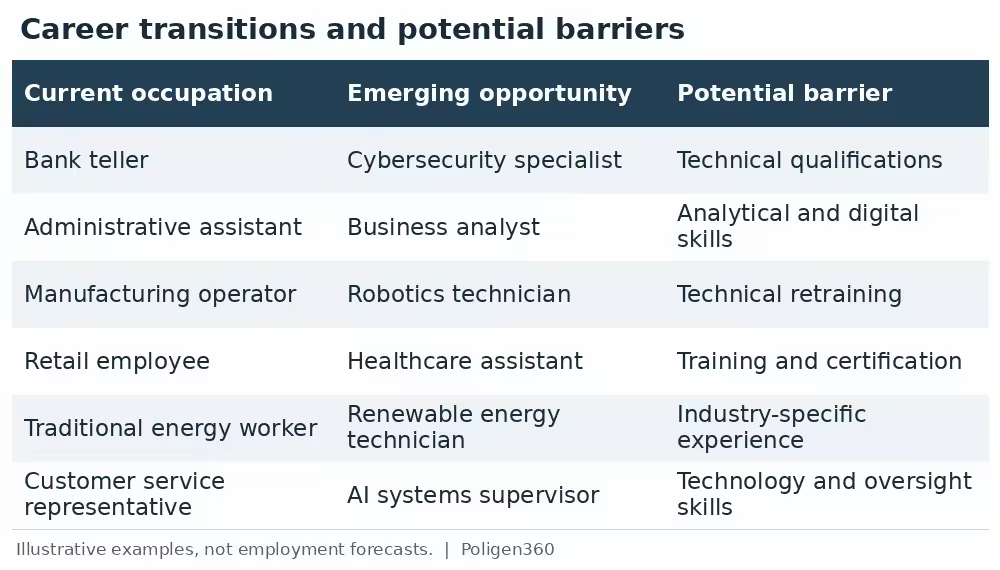
The existence of new jobs does not automatically mean displaced workers can move into them.
Age, geographical location, financial circumstances, educational background, family responsibilities and access to training can all influence a person’s ability to change careers.
A worker may also need to accept a temporary reduction in income while acquiring new qualifications or professional experience.
The OECD’s employment research emphasises the importance of relevant skills, continuing education and policies that support workers during changing labour market conditions.
The challenge is therefore not only creating employment opportunities but ensuring that workers can realistically access them.
9. Why are graduates and experienced professionals struggling to find jobs?
For decades, education and professional experience have been viewed as important pathways towards employment and financial stability.
While qualifications remain valuable, the transition from education into employment has become a concern in some economies.
The OECD’s 2026 research identifies a widening unemployment gap between younger workers and the broader workforce in several OECD countries. However, some of these difficulties began before generative AI became widely available.
According to the OECD’s Education at a Glance 2026, tertiary-educated adults continue to experience higher employment rates on average than people with lower levels of formal education.
This suggests that AI alone cannot explain the challenges facing graduates. Economic conditions, recruitment practices, competition for entry-level positions and the relationship between education and industry requirements must also be considered.
Could AI affect traditional entry-level career pathways?
Many professions have historically relied on junior employees performing routine work before progressing into more complex responsibilities.
If AI increasingly performs research, documentation, data processing, basic analysis and routine administrative tasks, businesses may reconsider how many junior employees they recruit.
This raises another question: if traditional entry-level positions become less common, how will future professionals acquire the experience required to become senior specialists?
This is a potential long-term challenge rather than an established outcome across all industries.
Experienced professionals may face a different challenge. Their existing knowledge remains valuable, but changes in technology and business processes may create pressure to develop additional capabilities.
Formal education and experience will continue to matter, but continuous learning could increasingly influence career progression.
10. Why does unemployment vary across countries despite an improving global trend?
Global unemployment figures represent an aggregate picture of economies operating under very different economic, political, demographic and technological conditions.
Individual countries can experience rising unemployment even when the worldwide rate remains relatively stable or declines. Similarly, some countries may maintain exceptionally low unemployment rates while others face significant employment challenges.
Understanding these differences is important because global unemployment statistics do not necessarily reflect the employment conditions experienced by individuals in particular countries, industries or regions.
Global unemployment compared with selected countries
The following table compares estimated unemployment rates across selected economies using annual data for 2025.
| Country | Unemployment rate (2025) |
|---|---|
| World | 4.79% |
| Australia | 4.09% |
| New Zealand | 5.08% |
| United States | 4.20% |
| Canada | 6.91% |
| United Kingdom | 4.75% |
| Germany | 3.71% |
| France | 7.54% |
| Spain | 10.38% |
| China | 4.62% |
| Japan | 2.45% |
| South Korea | 2.68% |
| India | 4.22% |
| Malaysia | 3.76% |
| Singapore | 2.82% |
| Indonesia | 3.24% |
| Philippines | 2.24% |
| Vietnam | 1.52% |
| Thailand | 0.78% |
| Brazil | 5.97% |
| South Africa | 32. |
World Bank – Unemployment Statistics (ILO Modelled Estimates) | World Bank Dataset – Country-by-Country Comparison | ILOSTAT Data Portal
Note: All figures in the table represent 2025 annual ILO modelled estimates, rounded to two decimal places. These estimates may differ from unemployment figures published by individual national statistical agencies and are subject to revisions.
What does the international comparison reveal?
The differences between countries are considerable. While economies such as Japan, South Korea and Singapore recorded unemployment rates below 3%, countries such as Canada, France, Spain and South Africa experienced substantially higher rates.
Even neighbouring countries with close economic relationships, such as Australia and New Zealand, recorded different unemployment rates.
These differences demonstrate that global employment trends cannot be interpreted as a uniform experience across all economies.
Why do countries experience different employment conditions?
Several factors can influence national employment trends independently of developments in artificial intelligence and automation.
| Factor | Potential impact on employment |
|---|---|
| Economic growth | Influences business expansion and recruitment |
| Interest rates | Affect borrowing, investment and consumer spending |
| Population growth and migration | Change the size and composition of the workforce |
| Ageing populations | May contribute to labour shortages in certain industries |
| Industrial structure | Determines demand for manufacturing, services and technical skills |
| Government expenditure | Influences public-sector employment and infrastructure projects |
| International trade | Affects export-oriented industries and domestic production |
| Education and skills | Influence workers’ access to available employment opportunities |
| Business operating costs | Affect recruitment, expansion and workforce restructuring |
| Technology and automation | Change productivity and demand for particular occupations |
| Political and economic stability | Influence investment and long-term business confidence |
| Informal employment | Can affect job security, income stability and working conditions |
How employment challenges differ around the world
Australia and New Zealand
Employment conditions can be influenced by household spending, interest rates, construction activity, migration, tourism and business investment. Changes in domestic demand can affect recruitment even when global employment remains relatively stable.
Australian Bureau of Statistics – Labour Force | Stats NZ – Economic Indicators
United States and Canada
Economic growth, business investment, consumer spending, trade policies and technological adoption can influence employment opportunities. Corporate restructuring and changing workforce requirements may affect particular occupations even when national unemployment remains relatively moderate.
US Bureau of Labor Statistics | Statistics Canada – Labour Statistics
United Kingdom and Germany
Employment conditions can be affected by economic growth, energy costs, industrial competitiveness, demographic changes and investment. Manufacturing-intensive economies may also experience employment pressures as industries transition towards automation, electrification and new production technologies.
UK Office for National Statistics – Labour Market | Germany’s Federal Statistical Office – Labour Market | Eurostat – Employment and Unemployment
Japan and South Korea
Ageing populations and demographic changes can create labour shortages in certain industries. Automation and robotics may help businesses address workforce shortages rather than simply replace existing employees.
However, relatively low national unemployment does not mean that all workers enjoy secure employment, satisfactory wages or favourable working conditions.
Source: OECD – Employment Outlook
China and India
These large economies contain diverse labour markets influenced by industrial development, urbanisation, education, manufacturing, digital services and changing workforce requirements.
Employment challenges may differ considerably between rural and urban areas, younger and older workers, and formal and informal sectors.
World Bank – Jobs and Development | ILOSTAT – International Labour Statistics
Malaysia, Singapore and other Southeast Asian economies
Manufacturing, electronics, financial services, tourism, international trade and digital industries contribute to employment across Southeast Asia, although the importance of each sector varies considerably by country.
Some economies may benefit from industrial investment and technological development, while workers in other sectors may face increasing pressure to acquire new skills.
Informal employment and job quality also remain important considerations when interpreting relatively low unemployment rates in parts of Southeast Asia.
ASEANstats Data Portal | ILO – Asia and the Pacific
Does low unemployment mean every country is performing well?
Not necessarily.
A country may record a low unemployment rate while experiencing significant challenges involving:
- Low wages and limited purchasing power.
- Informal and insecure employment.
- Underemployment.
- Youth unemployment.
- Skills shortages.
- Limited career progression.
- Regional employment inequalities.
- Workers leaving the labour force.
The OECD’s Employment Outlook 2026 highlights that relatively high employment levels can coexist with weakening recruitment conditions and persistent shortages of workers with particular skills.
Can artificial intelligence explain unemployment differences between countries?
Artificial intelligence is one of several factors influencing the future of employment. However, attributing rising unemployment entirely to AI would overlook the many economic, demographic and structural conditions affecting individual countries.
In countries experiencing labour shortages, automation could help businesses maintain productivity despite a limited workforce. In countries experiencing weak economic growth or insufficient job creation, automation could introduce additional employment challenges if displaced workers struggle to find alternative opportunities.
These are potential outcomes rather than universal predictions.
Ultimately, the impact of technology on employment will depend on the economic circumstances of each country, the industries adopting automation, the availability of alternative employment opportunities and the ability of workers to adapt.
The global unemployment rate provides a valuable overview of the world’s labour market, but understanding the employment situation within individual countries requires a much broader examination of local economic conditions, wages, skills, job quality and workforce participation.
A declining global unemployment rate does not necessarily mean employment conditions are improving everywhere. Equally, rising unemployment in one country does not necessarily indicate a worldwide employment crisis.
11. Is the fear of mass unemployment genuine or simply hype?
The available evidence suggests that there are legitimate reasons for concern, but also reasons to question some of the more extreme predictions.
What does the evidence currently support?
| Concern or prediction | What the evidence suggests |
|---|---|
| AI will automate certain tasks | Supported by research and employer expectations |
| Some existing occupations will decline | Supported by employment projections |
| Businesses may operate with fewer workers | Anticipated by some surveyed employers |
| New occupations and industries will emerge | Supported by employment projections |
| AI has already caused widespread global unemployment | Not established by current evidence |
| Almost all human jobs will disappear | Not established by current evidence |
| Every displaced worker will find an equivalent job | Cannot be guaranteed |
| Workers will need to adapt their skills | Supported by workforce research |
Another possible factor is the visibility of job losses compared with job creation.
When a large multinational company announces thousands of redundancies, it can attract considerable public attention. In contrast, smaller businesses recruiting a few employees each may receive little coverage, even when their combined employment contribution is significant.
This is a possible explanation for differences between public perceptions and broader employment statistics, rather than a measured conclusion about media coverage.
The danger lies in interpreting individual redundancy announcements as definitive evidence of a global employment collapse. Equally, it would be misleading to use low global unemployment as evidence that technological disruption poses no risk.
What happens when AI agents become increasingly autonomous?
Most current discussions about AI and employment focus on systems that assist humans in performing individual tasks.
However, increasingly autonomous AI agents could potentially manage complete workflows, coordinate multiple software systems and carry out activities with considerably less human supervision.
Future systems may also be capable of designing, testing and deploying additional AI agents within defined technical and organisational limits.
Such developments could change not only how individuals work but also how businesses organise their operations.
Consider a hypothetical small company:
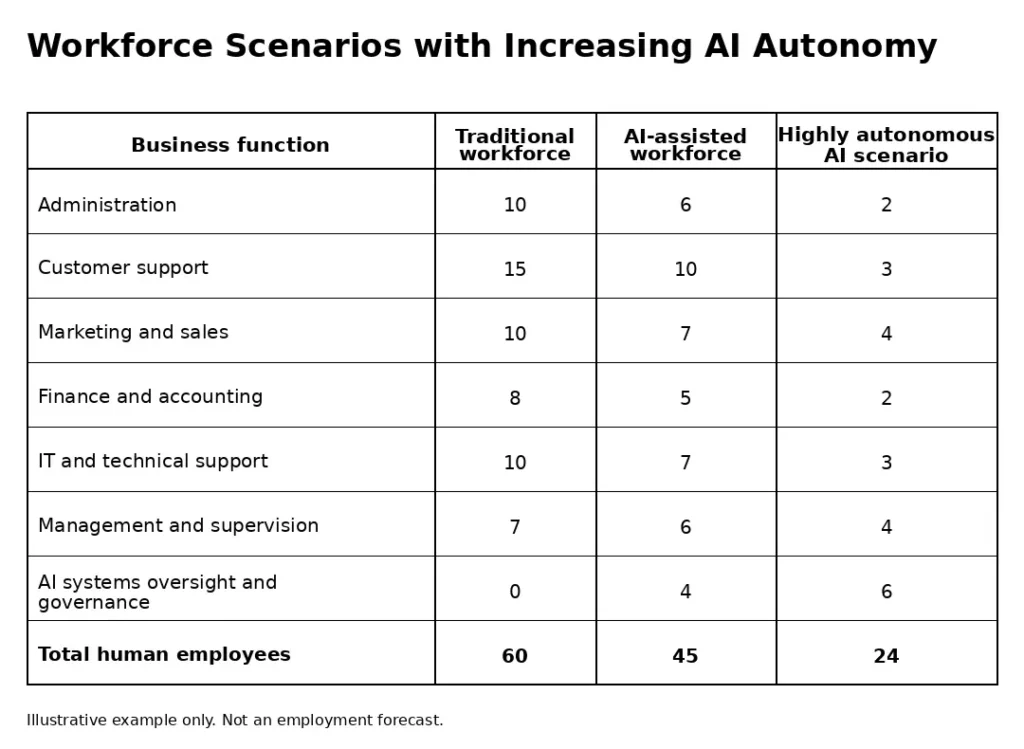
This is a hypothetical scenario designed to illustrate the potential relationship between automation, organisational restructuring and employment. It is not a prediction or a measured workforce reduction.
In this example, new employment opportunities emerge in AI oversight and governance. However, these new roles do not fully compensate for the reduction in traditional positions within the company.
If similar developments occurred across many organisations, the wider economy would need to generate sufficient employment elsewhere to compensate for displaced workers.
An ILO research brief published in May 2026 also examines why productivity improvements achieved through AI at the individual task level have not necessarily translated into equivalent gains across entire businesses or economies.
The future impact of autonomous AI agents will depend on their capabilities, reliability, implementation costs, regulation, cybersecurity, business adoption and the new economic activities they enable.
It remains uncertain whether increasingly autonomous AI will primarily complement human labour, substantially reduce workforce requirements or create entirely new forms of employment.
12. What skills will people need in the future?
The World Economic Forum estimates that approximately 39% of workers’ existing skills could change or become outdated between 2025 and 2030.
This does not mean that 39% of workers will lose their jobs. Instead, it suggests that many employees may need to develop new capabilities to remain effective in changing workplaces.
Importantly, adapting to the future does not necessarily mean that everyone needs to become a programmer, software engineer or AI specialist.
Skills that could remain valuable across different industries
| Skill category | Practical applications |
|---|---|
| Digital literacy | Using modern software and AI tools |
| Analytical thinking | Interpreting information and identifying trends |
| Problem-solving | Addressing complex operational challenges |
| Technical expertise | Engineering, maintenance and specialised trades |
| Communication | Explaining ideas, negotiating and collaborating |
| Leadership | Managing people and organisational change |
| Process improvement | Improving efficiency, productivity and quality |
| Creativity | Developing new products and services |
| Adaptability | Learning new systems and responding to change |
| Professional judgement | Making responsible and informed decisions |
| AI oversight | Checking automated decisions and AI-generated outputs |
| Risk management | Identifying operational, regulatory and technological risks |
The combination of industry-specific expertise and the ability to use emerging technologies may become increasingly important.
For example, an experienced engineer who understands AI-assisted design tools may bring together technical knowledge and digital productivity. Similarly, an administrative professional who understands automation, data analysis and process improvement may be able to transition into broader operational responsibilities.
These are possible career-development pathways rather than guarantees of employment security.
13. Who is responsible for preparing workers for the future?
Although individuals can invest in their own professional development, the responsibility for managing employment transformation should not rest entirely on workers.
Governments, educational institutions and businesses also have important roles to play.
| Stakeholder | Potential responsibilities |
|---|---|
| Governments | Employment policies, retraining support and social protection |
| Businesses | Employee development and responsible technology adoption |
| Universities | Updating qualifications to reflect industry requirements |
| Vocational institutions | Accessible practical and technical training |
| International organisations | Research, labour standards and policy cooperation |
| Individuals | Continuous learning and professional development |
A successful employment transition requires more than simply asking individuals to learn new skills. Training must be accessible, affordable and connected to genuine employment opportunities.
OECD – Employment Outlook 2026 | ILO – Employment and Social Trends 2026
If AI replaces workers, who will purchase goods and services?
This is another important economic question that deserves consideration.
Businesses rely not only on productivity but also on customers purchasing their products and services.
Employees are simultaneously consumers. Their earnings contribute to spending on housing, food, transportation, healthcare, education, entertainment and other economic activities.
Consider a hypothetical town where several major employers introduce highly autonomous AI systems.
Initially, those businesses may benefit from lower operating costs and increased productivity. However, if significant numbers of local workers lose their jobs or experience reduced incomes without finding alternative employment, household spending could decline.
This could affect other businesses that were not directly involved in adopting AI.
| Stage | Potential economic effect |
|---|---|
| Businesses introduce advanced automation | Productivity increases |
| Fewer employees are required | Labour costs decline |
| Some workers lose employment income | Household purchasing power may fall |
| Consumers reduce spending | Demand for goods and services may weaken |
| Local businesses experience lower revenue | Investment and recruitment may slow |
| Wider economic activity adjusts | New opportunities or further disruptions may emerge |
This is a hypothetical economic scenario, not a prediction of inevitable economic decline.
On the other hand, increased productivity could lower prices, create new products, improve purchasing power and encourage additional investment. Employment and incomes could also grow in newly emerging industries.
The ultimate outcome would depend on how the financial benefits of technological progress are distributed and whether they generate additional economic activity.
The International Monetary Fund has highlighted the possibility that AI could increase productivity and incomes while also widening inequality if its benefits are unevenly distributed.
Potential policy discussions could include shorter working weeks, employee profit-sharing, retraining programmes, stronger social protection, progressive taxation and alternative income-support arrangements.
These approaches involve different costs, benefits and implementation challenges. None represents a universally agreed solution.
The important question is not simply how much more an economy can produce using AI, but how people will participate in that economy and benefit from its increased productivity.
14. What should we monitor beyond unemployment statistics?
If we want to understand whether employment conditions are genuinely improving, unemployment rates should be considered alongside other economic and labour market indicators.
Employment indicators worth monitoring
| Indicator | What it tells us |
|---|---|
| Unemployment rate | Proportion of the labour force meeting unemployment criteria |
| Employment rate | Proportion of the relevant population that is employed |
| Labour force participation | How many people are working or actively participating in the labour market |
| Underemployment | Workers who want and are available for additional working hours |
| Job vacancies | Demand for workers |
| Real wage growth | Whether earnings are increasing after accounting for inflation |
| Youth unemployment | Employment challenges facing younger workers |
| Long-term unemployment | Difficulties experienced by people without work for extended periods |
| Informal employment | Employment outside certain formal arrangements and protections |
| Labour productivity | Economic output relative to labour input |
| Job quality | Earnings, security and working conditions |
| Skills shortages | Difficulty finding workers with particular capabilities |
| Household consumption | Consumer spending and purchasing power |
| Income inequality | How income is distributed across society |
| Labour income share | The proportion of economic income received through labour |
| Recruitment trends | Whether organisations are expanding or reducing hiring |
To understand whether employment conditions are genuinely improving, unemployment rates should be considered alongside other economic and labour market indicators.
Resources such as ILOSTAT Labour Force Statistics, World Bank Open Data and the OECD Employment Outlook 2026 provide a broader perspective on global employment trends, workforce participation, wages, productivity, job quality and changing labour market conditions.
Together, these indicators provide a more comprehensive understanding of employment conditions than a single headline unemployment figure.
In a future where businesses may produce more goods and services with fewer employees, understanding wages, household purchasing power and the distribution of productivity gains could become particularly important.
15.Could the future of employment be better than we currently imagine?
Much of the discussion surrounding artificial intelligence and automation focuses on what humanity could lose. However, it is equally important to consider what humanity could gain.
The decline in global unemployment over the past decade provides a reason to question the assumption that technological advancement inevitably leads to fewer employment opportunities.
Although the past cannot guarantee the future, artificial intelligence could help businesses become more productive, enable entrepreneurs to establish companies with fewer resources, reduce the cost of goods and services, and create entirely new markets and professions.
Some potential positive outcomes could include:
- New industries, businesses and employment opportunities.
- Greater opportunities for entrepreneurship and self-employment.
- Reduced exposure to dangerous, repetitive and physically demanding work.
- More affordable goods and services.
- Improved access to healthcare and education.
- Greater productivity among small and medium-sized businesses.
- New employment opportunities for people with disabilities.
- More flexible working arrangements.
- Shorter working weeks, where productivity gains allow.
- Improved living standards if economic benefits are widely distributed.
The World Economic Forum’s Future of Jobs Report 2025 projects that wider structural changes could create 170 million jobs while displacing 92 million existing jobs by 2030, resulting in a potential net employment increase of 78 million jobs.
Similarly, the International Monetary Fund has identified the potential for artificial intelligence to increase productivity, support economic growth and raise incomes, while acknowledging the risks of increasing inequality.
These potential benefits are not guaranteed. Much will depend on how technology is developed, adopted, regulated and integrated into the wider economy.
Perhaps the future of work should not be viewed exclusively through the lens of fear and job losses, but also through the possibilities of innovation, human adaptability and economic progress.
The future may not necessarily offer fewer opportunities. It may offer different opportunities from those we have traditionally known.
Beyond the Data: The Questions That Still Linger
While declining global unemployment provides reasons for optimism, the future of work remains an open question. Artificial intelligence and automation could introduce unprecedented opportunities alongside significant challenges.
As technology continues to reshape the global economy, the following questions deserve further consideration:
- Could artificial intelligence ultimately create more employment opportunities than it eliminates?
- Could technological advancements make goods and services more affordable and improve living standards?
- How will education and university qualifications evolve to meet future employment requirements?
- Could traditional trades and specialised human skills become more valuable in an increasingly automated world?
- Could increased productivity lead to shorter working weeks and a better work-life balance?
- Could AI make entrepreneurship, self-employment and business ownership more accessible?
- What happens when autonomous AI agents become capable of creating and managing other AI agents?
- If companies require fewer employees, how will economies maintain consumer purchasing power?
- How can the financial benefits of AI-driven productivity be shared more widely across society?
- Could technological progress help humanity build a more productive, prosperous and inclusive future?
The answers to these questions are not yet certain. However, uncertainty should not automatically be interpreted as a reason for pessimism. It may also represent an opportunity to rethink how we work, live and participate in the global economy.
Editorial Note : This article is intended for informational and educational purposes. It draws on publicly available statistics, reports and research from the International Labour Organization (ILO), World Bank, World Economic Forum (WEF), Organisation for Economic Co-operation and Development (OECD), International Monetary Fund (IMF) and Stats NZ, as available on 27 November 2026.Historical employment estimates are subject to statistical revisions. Future employment projections and employer expectations represent possible outcomes rather than guaranteed developments.
Examples involving workforce reductions, autonomous AI agents, individual incomes and local economic activity are hypothetical scenarios provided to explain economic concepts and potential developments. They should not be interpreted as confirmed forecasts.
This article does not constitute individual career, financial or employment advice.This article is intended for informational and educational purposes only. It provides analytical insights based on publicly available information and does not constitute financial, legal, or political advice. Readers are encouraged to consult official sources and expert advisors for verified guidance.