

From Bottles to Blueprints: Why the BAETA Breakthrough Matters for the Next Decade of Emissions
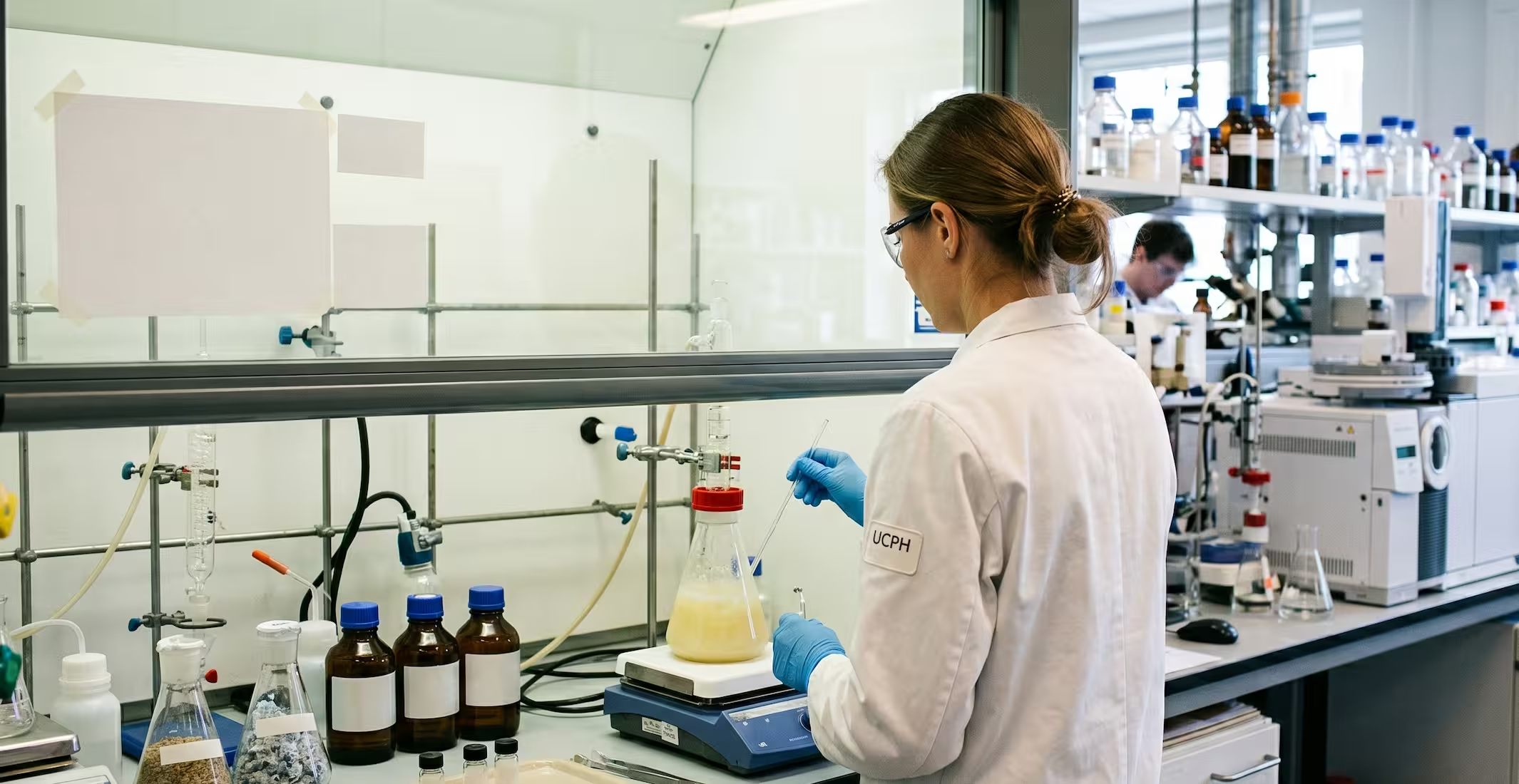
September 2025 : In a breakthrough that could reshape both waste management and climate strategy, chemists at the University of Copenhagen have developed a new material that transforms discarded plastic into a powerful tool for capturing carbon dioxide.
The innovation centers on PET plastic commonly found in bottles and textiles which is chemically restructured into a substance called BAETA. This powdery material binds CO₂ from industrial exhaust with remarkable efficiency, offering a scalable solution for emission-heavy sectors.
Lead researcher Margarita Poderyte describes the process as “upcycling pollution into prevention.” Unlike traditional carbon capture systems, BAETA is made at ambient temperatures and can be reused after heating, making it both sustainable and cost-effective.
The team hopes the technology will be deployed in factories, where chimney emissions can be filtered through BAETA units. Even degraded ocean plastics, often unsuitable for recycling, could become raw material for this climate-positive transformation.
Why the BAETA Breakthrough Defines the 2025 Climate Strategy
The innovation developed by the University of Copenhagen represents more than just a clever laboratory experiment; it signals a fundamental shift in how we perceive the relationship between solid waste and atmospheric pollution. As we navigate the complexities of 2025, the global community is increasingly aware that meeting net-zero targets requires “triple-win” solutions technologies that simultaneously reduce landfill pressure, lower industrial costs, and scrub existing emissions.
A Strategic Convergence of Two Crises
For decades, environmental policy treated plastic pollution and carbon emissions as separate battlefields. We fought one with recycling bins and the other with carbon taxes. The development of BAETA (Beta-Amino-Ethyl-Triamine-functionalized Alumina) changes that calculus. By restructuring PET plastic a material that currently accounts for a massive portion of global textile and packaging waste chemists have essentially turned a liability into a high-value asset.
This is particularly vital in 2025, as traditional mechanical recycling faces economic headwinds. When plastic degrades in our oceans or becomes contaminated, it usually loses its value. However, the University of Copenhagen’s research proves that even “unrecyclable” PET can be chemically converted into a carbon-binding powder. This ensures that the more we clean our environment, the more tools we create to protect our atmosphere.
Breaking the Economic Barrier of Carbon Capture
One of the primary hurdles for Carbon Capture and Storage (CCS) has been the “energy penalty” the immense amount of power required to capture and then release CO₂ from traditional filters. As outlined in the team’s peer-reviewed study in Science Advances, BAETA offers a low-energy alternative.
Because the material is produced at ambient temperatures and can release its captured CO₂ for storage with significantly less heat than current industry standards, it becomes economically viable for medium-sized factories, not just massive power plants. This scalability is the “missing link” for emission-heavy sectors like cement and steel production, which have struggled to find affordable decarbonization tools.
The Path to a Circular Economy
As we look toward the 2030s, the implications of this breakthrough are profound. We are moving toward a Circular Shield economy. In this model, the lifecycle of a plastic bottle doesn’t end at a landfill; it evolves into a filter for a green-hydrogen plant or a local manufacturing hub.
The significance of the University of Copenhagen’s work lies in its practicality. Lead researcher Margarita Poderyte and her team have demonstrated that this isn’t just a theoretical future—it is a chemical reality today. By upcycling our past mistakes (plastic waste), we are finally building the infrastructure to secure our future. This is the definition of climate-positive innovation: using what we have to fix what we’ve broken.
Editorial Note: This article is intended for informational and educational purposes only. It provides analytical insights based on publicly available information and does not constitute financial, legal, or political advice. Readers are encouraged to consult official sources and expert advisors for verified guidance.
European Scholarships for New Zealand Students: Your Pathway to Success
Did You Know? The European Youth Event Brings Thousands of Young People Together Every Two Years