

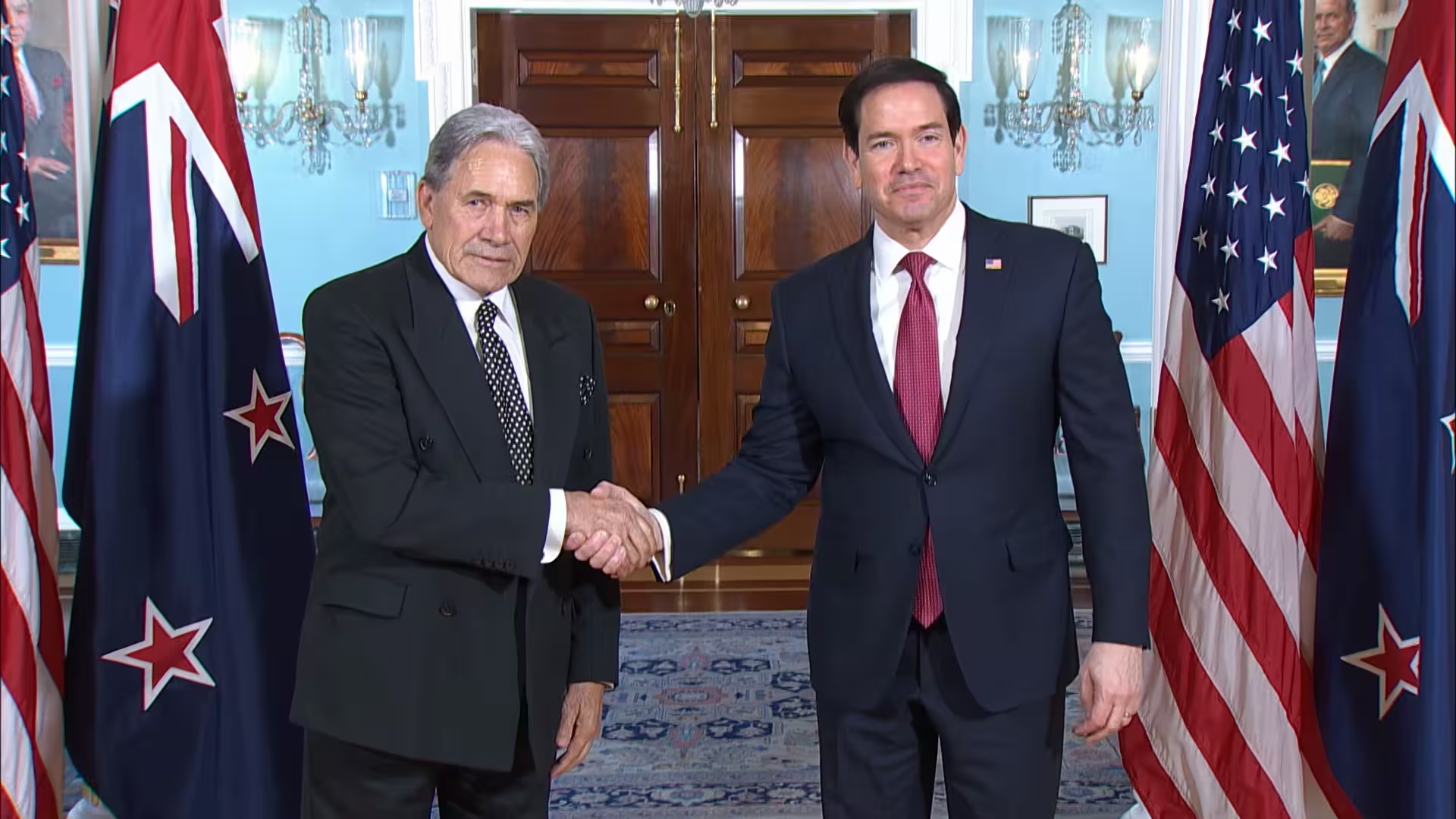
Foreign Minister Rt Hon Winston Peters Meets Marco Rubio in Washington as New Zealand Warns of Deepening Global Instability
WASHINGTON, D.C. : April 11, 2026 : New Zealand Foreign Minister Winston Peters has used a high-level visit to Washington to underline the seriousness of the current international environment, warning before departure that the global context is the most challenging New Zealand has faced in the past 80 years.
During the visit, Peters met U.S. Secretary of State Marco Rubio for talks covering the bilateral relationship, the conflict involving Iran, cooperation on critical minerals supply chains, and prosperity and security in the Pacific Islands region. The meeting reflected both countries’ interest in maintaining close coordination at a time of heightened geopolitical uncertainty.
According to the U.S. State Department, Rubio and Peters “applauded the enduring friendship between New Zealand and the United States” and reaffirmed their commitment to advancing shared interests and strategic priorities. That language signals continuity in the relationship, but it also shows that the discussion went beyond routine diplomacy. The agenda touched on issues that sit at the intersection of security, economics, and regional influence.
Before leaving for Washington, Peters said the visit would focus on New Zealand’s shared commitments with the United States in the Pacific and Indo-Pacific, as well as major international developments, particularly the conflict in the Middle East and its effects on this region. He said the meetings would advance New Zealand’s diplomatic, security, and economic interests while helping both sides better understand each other’s priorities.
That framing matters. For New Zealand, developments far from home are no longer distant strategic questions. Instability in the Middle East can affect shipping, energy markets, supply chains, investor confidence, and broader regional security.
Peters made that connection more explicit after the Washington meeting, when he welcomed announcements by the United States and Iran that pointed toward a ceasefire, while also warning that major work remained ahead.
“While this is encouraging news, there remains significant important work to be done in the coming days to secure a lasting ceasefire,” Peters said in a post-visit statement. He also thanked Pakistan, and others such as Türkiye and Egypt, for work aimed at finding a solution to the crisis.
His wording was cautious rather than celebratory. New Zealand welcomed signs of de-escalation, but not as a final resolution.
That is an important distinction. The official statements do not present the crisis as settled. Instead, they show Wellington treating the moment as fragile, fluid, and still capable of producing wider disruptions.
Peters also tied the conflict directly to New Zealand and the Pacific. “As we discussed with Secretary of State Marco Rubio today, this conflict has had wide-ranging impacts and disruptions – for both those in the Middle East and further afield including in New Zealand and the Pacific region,” he said.
That line is one of the most important in the entire episode, because it explains why the Washington meeting mattered beyond diplomacy itself. New Zealand is geographically distant from the Middle East, but it is not insulated from global shocks.
A conflict that disrupts markets, trade routes, or confidence can quickly become relevant to smaller economies and island regions that depend heavily on stable international flows of goods, transport, and energy.
The discussion on critical minerals also deserves attention. The State Department’s summary shows that cooperation on critical minerals supply chains was part of the talks, placing the meeting within a broader strategic trend. Critical minerals are increasingly tied to economic resilience, advanced manufacturing, clean energy technologies, electronics, and wider competition over secure supply chains. For New Zealand, even brief inclusion of this issue in a senior bilateral meeting suggests that the relationship is expanding beyond traditional diplomacy into more strategic economic territory.
The Pacific Islands region was another major point of focus. The official U.S. readout said the two sides discussed “advancing prosperity and security in the Pacific Islands region,” while Peters had earlier said he intended to discuss cooperation in the Pacific and Indo-Pacific.
That shared language points to a consistent theme: both governments see the Pacific not only as a neighborhood issue, but as a strategic space where economic development, security, and political relationships increasingly overlap.
This is where the visit takes on wider meaning. Peters’ trip was not simply about one meeting or one crisis. It was also about showing that New Zealand wants to remain engaged with major partners while protecting its own interests in a rapidly changing international environment. His “80 years” comment before departure was unusually stark, and it appears designed to communicate that New Zealand sees today’s global pressures as unusually serious by historical standards.
The official material also suggests a careful diplomatic balance. New Zealand welcomed ceasefire efforts and supported moves toward a durable end to hostilities, while also reinforcing bilateral ties with Washington and affirming shared strategic interests.
That balance matters for a country like New Zealand, which often seeks to combine principled diplomatic language with practical engagement on security and regional stability.
“In the coming days and weeks, New Zealand will stand in support of all efforts to bring about a lasting, durable end to this conflict,” Peters said after the meeting. That closing message places New Zealand on the side of continued diplomacy, while leaving room for further international coordination if the situation remains unstable.
Taken together, the Washington visit produced no dramatic single announcement, but it did deliver something politically important: a clear public alignment between Wellington and Washington on the need to manage strategic risk, support regional stability, and respond to the wider effects of international conflict. At a time when crises in one region can rapidly affect countries far beyond it, Peters’ visit underscored a simple point New Zealand sees global instability as a direct national and regional concern, not a distant one.
Editorial Note: This article is intended for informational and educational purposes only. It provides analytical insights based on publicly available information and does not constitute financial, legal, or political advice. Readers are encouraged to consult official sources and expert advisors for verified guidance.
Strengthening Diesel Storage Resilience: Government Action at Marsden Point
NZ’s Energy Future: Why People, Not Just Power, Are the Priority