

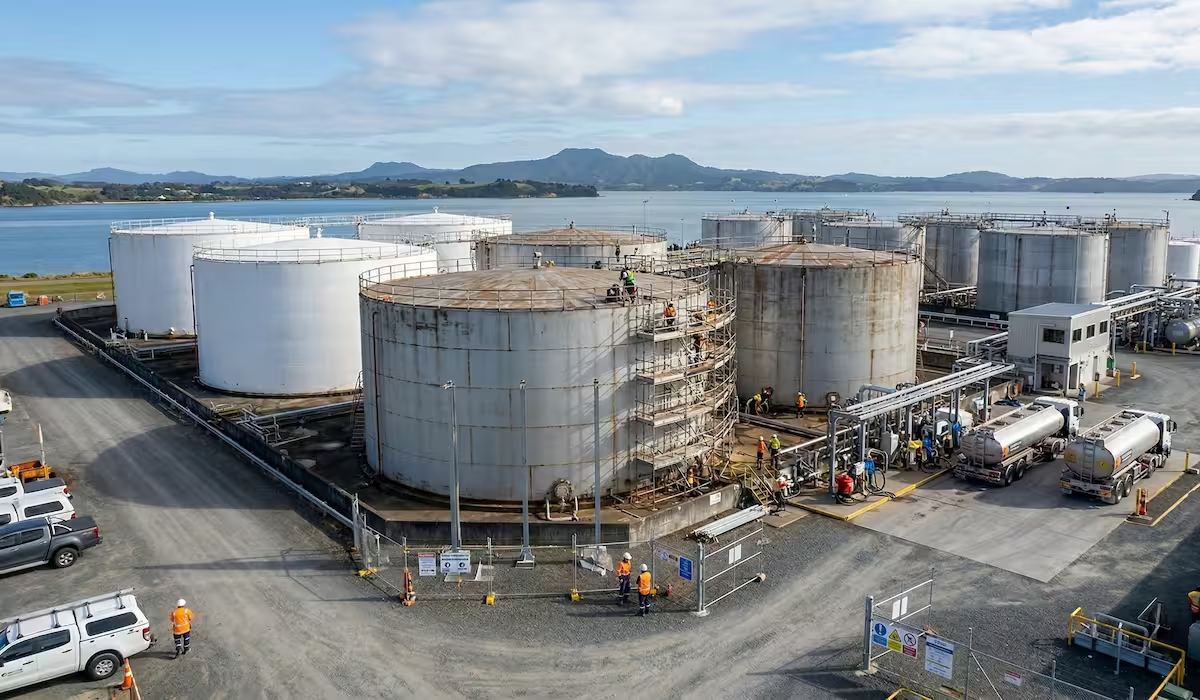
NORTHLAND 3rd April 26 – In a move to safeguard New Zealand’s economy against global volatility, the Government has announced a strategic agreement to restore 90 million litres of diesel storage capacity at Marsden Point.
Regional Development and Associate Energy Minister Hon Shane Jones confirmed that up to $21.6 million from the Regional Infrastructure Fund (RIF) has been allocated to Channel Infrastructure NZ Ltd to fast-track the project. The decision comes as the ongoing Middle East conflict continues to pose a threat to international fuel supply chains.
Restoring a National Asset
The funding will allow for the urgent recommissioning of storage tanks at the site of the former oil refinery.
While the facility shifted from refining to a dedicated import terminal in 2022, several large-scale tanks have remained idle.
“While we are acutely aware of the importance of petrol and jet fuel, it is diesel that is the lifeblood of our economy,” Minister Jones stated. He emphasized that although current supplies are secure through May, the ability to store surplus fuel is a critical necessity.
Rapid Turnaround at Marsden Point
The project is characterized by its speed, with work expected to begin within days. Channel Infrastructure has assured the Government that the 90-million-litre capacity equivalent to roughly eight days of national supply can be fully operational within two months.
The Government intends to monitor progress closely, ensuring the infrastructure is ready to receive diesel shipments at the earliest opportunity.
The Role of the Regional Infrastructure Fund
The investment is being drawn from the Regional Infrastructure Fund (RIF), utilizing capital previously tagged for projects that were approved in principle but unlikely to proceed.
By pivoting these funds to fuel resilience, the Government aims to provide a “buffer” for the primary sectors specifically farming, freight, and emergency services that rely heavily on diesel to function.
Fact Sheet: Why Marsden Point Matters
- Location & History: Marsden Point is a deep-water port in Northland. For decades, it was the site of New Zealand’s only refinery. Today, it serves as the country’s primary fuel gateway. You can learn more about its transition from refining to infrastructure at channel infrastructure.
- Strategic Importance: As an island nation, New Zealand is vulnerable to shipping delays. Expanding storage at a proven hub like Marsden Point allows the country to hold larger “rainy day” reserves.
- Economic Impact: Diesel powers the heavy transport and agricultural machinery that keeps New Zealand’s export economy moving. Increasing storage capacity directly protects these sectors from price spikes and supply shortages.
Editorial Note: This article is intended for informational and educational purposes only. It provides analytical insights based on publicly available information and does not constitute financial, legal, or political advice. Readers are encouraged to consult official sources and expert advisors for verified guidance.
NZ’s Energy Future: Why People, Not Just Power, Are the Priority
Strong Solidarity Drives 400-Million-Barrel IEA Emergency Oil Release