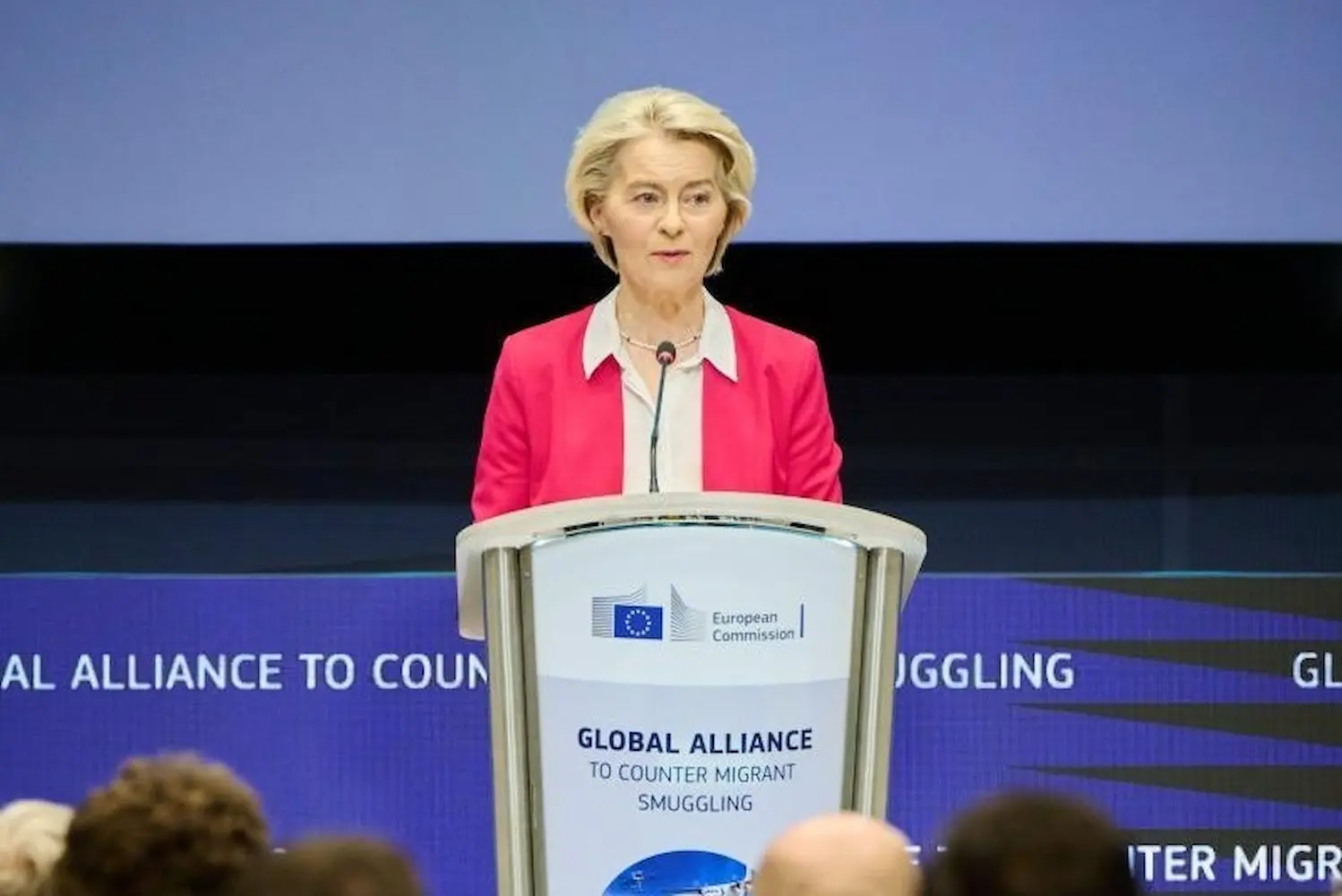
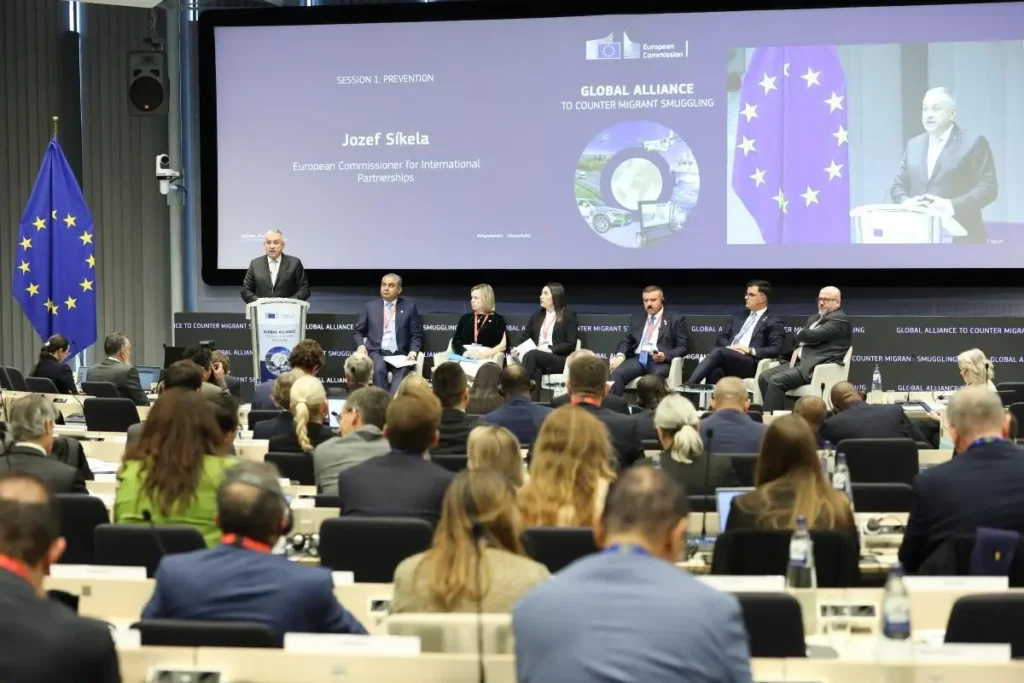
December , 2025 – The second International Conference of the Global Alliance to Counter Migrant Smuggling was held in Brussels on 10 December 2025, bringing together governments, EU agencies, partner countries and international organizations to strengthen cooperation against migrant smuggling networks.
The conference was convened by European Commission President Ursula von der Leyen and Commissioner for Internal Affairs and Migration Magnus Brunner. It followed the launch of the Global Alliance in November 2023 and aimed to build on two years of international cooperation.
She said criminal networks were making large profits from false promises, while many people continued to risk their lives during illegal border crossings.
Von der Leyen opened her address by referring to a recent trial in the Netherlands involving the alleged leader of an international smuggling network. She said victims had described severe abuse during journeys from Africa to Europe, including violence, starvation and exploitation.
According to her remarks, the dismantling of that network was made possible through cooperation between European and African countries, including the Netherlands, Italy, the United Kingdom, Libya and Ethiopia.
The European Commission President said this example showed why international action was essential. She said migrant smuggling could not be tackled by targeting only one part of the chain, but required action against the full criminal network.
Von der Leyen also said the EU had changed its migration policy over the past two years. She referred to the adoption of the first Solidarity Measures, which begin the implementation of the Pact on Migration and Asylum. She also noted that the Council had adopted a common position on returns and safe countries, opening the way for talks with the European Parliament.
According to the Commission President, numbers on key migration routes have fallen by 26% since the beginning of 2025, following a 37% drop on the same routes in 2024.
She also said more than EUR 12 million in illegal assets had been seized in Europe last year, including boats and firearms.
A central outcome of the Brussels conference was the endorsement of a joint Declaration. Von der Leyen described it as a blueprint for ending the business model of migrant smuggling across the world.
The Declaration is based on three main principles: preventing illegal journeys offered by smugglers, responding to the changing methods used by smuggling networks, and showing vulnerable people that safer alternatives exist.
On prevention, von der Leyen said avoiding a smuggling journey could mean saving a life. She linked this work to the EU’s wider partnerships with other countries, including investment, job creation, migration management, border control and anti-smuggling action.
The Brussels conference also saw participation from senior European Commission figures, including President Ursula von der Leyen, Executive Vice-President Henna Virkkunen, and Commissioners Magnus Brunner, Jozef Síkela and Maria Luís Albuquerque. More than 80 delegations from EU Member States, international partners and organisations attended the event, highlighting the wider global effort to strengthen cooperation against migrant smuggling.
She also called for rapid response information campaigns to warn people about the risks of illegal crossings. She said countries of origin had an important role in shaping these campaigns so that they reached the right audiences in an effective way.
The digital side of migrant smuggling was also highlighted. Von der Leyen said many dangerous journeys are now advertised online, making digital enforcement a key part of the response.
She said the EU had already worked with digital platforms in areas such as drug trafficking, terrorist propaganda and child abuse, and had expanded similar work to migrant smuggling since May.
Europol is developing operational guidance to help detect smuggling content online. Von der Leyen said recent joint work between European and partner-country experts had helped identify social media profiles linked to smugglers, uncover new leads and disrupt smuggling activity.
The second pillar of the Alliance focuses on stronger action against smuggling as a crime. Von der Leyen said Europol would receive more funding and staff, while the European Centre Against Migrant Smuggling would have an enhanced role, including liaison officers in partner countries.
She also said the Commission would propose strengthening Frontex by tripling its border force to 30,000 officers.
Another major focus was financial tracking. Von der Leyen said authorities needed to follow the money behind smuggling operations, trace illicit financial flows and act against underground banking systems used by criminal networks.
She said Europe was developing a new sanctions regime against smugglers in coordination with G7 partners. The aim would be to freeze assets, issue travel bans and weaken the financial base of smuggling networks.
Von der Leyen also said smugglers were changing their transport methods. While private boats and trucks have traditionally been used, commercial transport is increasingly being exploited. She said closer cooperation with transport companies, airports and law enforcement would be needed on key routes.
She also pointed to recent progress through the International Civil Aviation Organization, saying ICAO would step up efforts to help prevent migrant smuggling and illegal migration.
The speech also linked migrant smuggling to labour exploitation. Von der Leyen said people who cross borders illegally can later face exploitation without rights or protection, describing this as a form of modern slavery.
She said Europe must do more to fight labour exploitation, including by giving the European Labour Authority a stronger role in supporting Member States.
The third pillar of the Alliance focuses on safer alternatives. Von der Leyen said the EU’s Global Gateway strategy was helping create jobs, skills and vocational training opportunities around the world.
She also called for more legal pathways to Europe, including Talent Partnerships that connect skilled workers with labour needs in Europe. So far, five countries have joined these partnerships.
Von der Leyen also mentioned a new Talent Pool designed to match European employers with non-European jobseekers. She said a pilot Gateway Office in India would offer legal work opportunities in Europe and could become a model for similar partnerships with other countries.
At the end of her speech, von der Leyen said the Alliance would now move into a more formal structure, with a permanent secretariat and permanent funding.
She said the EU would deepen cooperation with organizations such as the G7, the Council of Europe and UN agencies, while calling on more countries and organizations to support the Declaration.
The conference marked a renewed effort by the EU and its partners to disrupt migrant smuggling networks, protect people from dangerous journeys, and expand safer legal options for mobility.
Key Points
The second International Conference of the Global Alliance to Counter Migrant Smuggling took place in Brussels on 10 December 2025.
The conference was convened by European Commission President Ursula von der Leyen and Commissioner Magnus Brunner.
The meeting brought together EU Member States, partner countries, EU agencies and international organizations.
Von der Leyen said Europe must decide who enters its borders and under what circumstances, not smugglers or traffickers.
A joint Declaration was endorsed as a blueprint to disrupt the migrant smuggling business model.
The Alliance focuses on prevention, stronger action against criminal networks, and safer legal alternatives.
Europol is developing guidance to help detect migrant smuggling activity online.
The EU plans to strengthen Europol, expand the role of the European Centre Against Migrant Smuggling, and propose a larger Frontex border force.
Europe is also developing a sanctions regime against smugglers in coordination with G7 partners.
The EU wants to expand legal pathways through Talent Partnerships, a new Talent Pool, and a pilot Gateway Office in India.
European Commission : remarks by President Ursula von der Leyen at the second Conference of the Global Alliance to Counter Migrant Smuggling, Brussels, 10 December 2025.
Editorial Note: This article is intended for informational and educational purposes only. It provides analytical insights based on publicly available information and does not constitute financial, legal, or political advice. Readers are encouraged to consult official sources and expert advisors for verified guidance.