

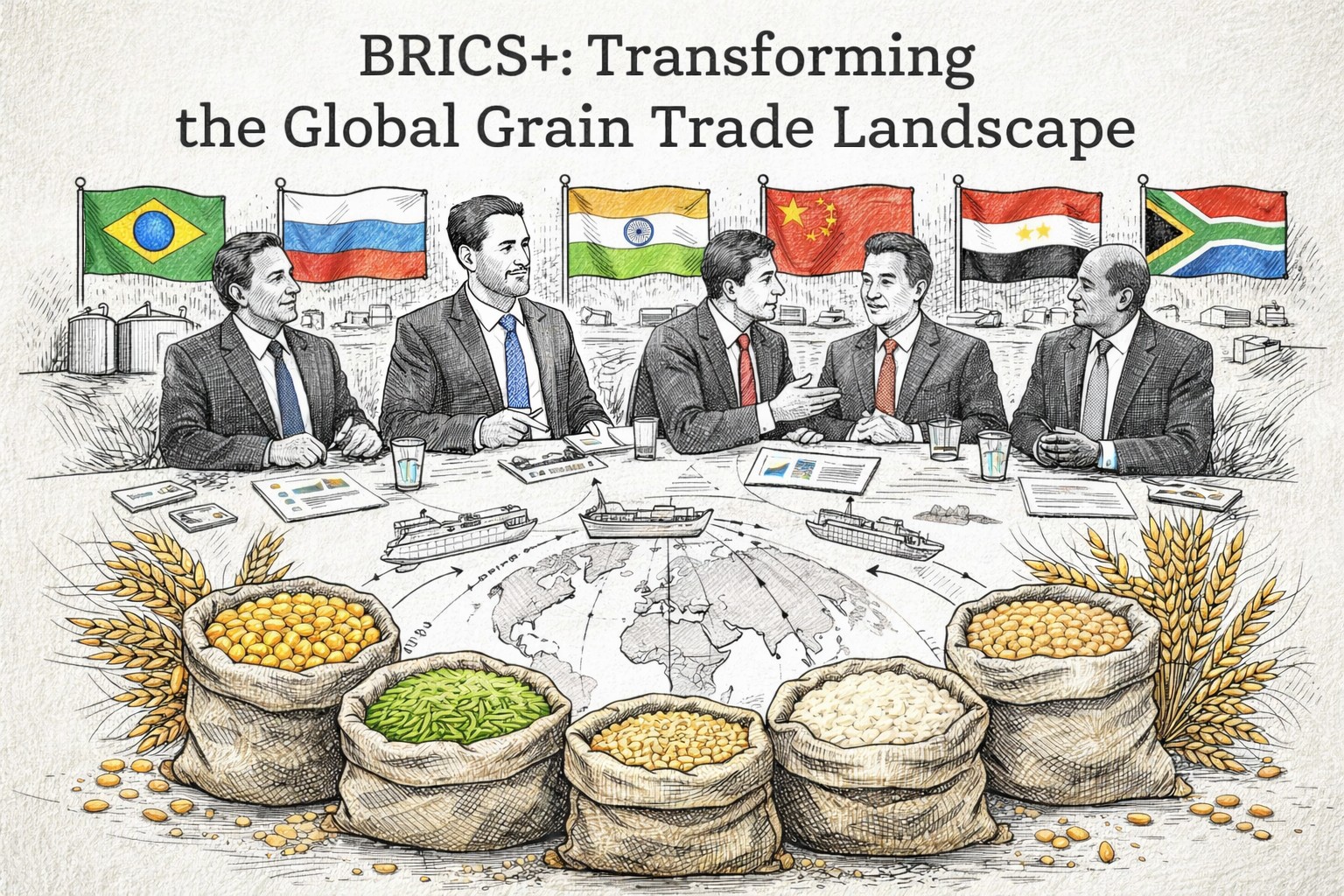
17th April 2025 | The BRICS+ alliance is cementing its position as a leading force in global agriculture, with significant strides in the grain trade sector. Recent developments, including the creation of the BRICS+ Grain Exchange, have solidified the bloc’s growing influence in the global food economy.
This initiative, launched in 2024, enables member nations to conduct transactions in their local currencies, reducing dependence on traditional agricultural systems dominated by the West.
BRICS+ members, including Brazil, Russia, India, China, and South Africa, have become global leaders in grain production, producing over 50% of the world’s supply. These nations are major exporters of key staples such as wheat, soybeans, and corn.
New members such as Kazakhstan and Indonesia are further enhancing the alliance’s agricultural contributions, adding greater weight to its market presence.
China continues to lead global grain production, generating an estimated 706.5 million tons annually. Brazil, with its anticipated output of 322.3 million tons, has secured its position as a top global supplier of soybeans and corn.
Russia’s status as a key wheat exporter is bolstered by its impressive grain production of 125 million tons, while India’s output surpasses 110 million tons, placing it among the world’s leading producers. South Africa, though comparatively smaller at 15.2 million tons, plays a vital role as a prominent maize exporter within Africa.
The agricultural influence of BRICS+ extends well beyond its founding members. Nations like Kazakhstan and Uzbekistan bring significant wheat production capabilities to the table, while Indonesia and Malaysia contribute to the alliance’s strength with their production of rice and palm oil.
Middle Eastern partners, including Iran, Saudi Arabia, and the UAE, have invested heavily in grain storage infrastructure and production capacity to ensure lasting food security for the region.
In Africa, countries like Nigeria and Uganda are steadily increasing their grain outputs to satisfy growing domestic and regional demands.
Beyond economic benefits, these developments aim to address food security challenges within BRICS+ countries, while also creating ripple effects in global trade patterns.
By shifting the center of agricultural power, the alliance is playing a critical role in redefining access to and pricing of essential food commodities.
As BRICS+ expands its agricultural initiatives, it continues to challenge conventional global trade structures, laying the foundation for a more multipolar food economy.
This transformative step positions the bloc as a formidable entity in the fight against global hunger and as a dominant player in the grain market for years to come.
Source: BRICS
What is the BRICS+ Alliance?
The BRICS+ alliance is an international group of some of the world’s fastest-growing economies. Originally known as “BRICS” (representing Brazil, Russia, India, China, and South Africa), the group took a historic step on January 1, 2024, by inviting new members to join. This expansion turned the group into “BRICS+,” a powerful bloc that represents a large portion of the world’s population, energy resources, and economic power.
Who are the Members?
As of April 2025, the alliance has grown to include a diverse group of nations:
- The Original Five: Brazil, Russia, India, China, and South Africa.
- The New Members: Egypt, Ethiopia, Iran, and the United Arab Emirates (UAE).
- Ongoing Interest: Dozens of other countries, including Saudi Arabia and various Southeast Asian nations, are currently in talks to join or cooperate with the group.
Why was BRICS+ Created?
The main goal of BRICS+ is to create a “multipolar” world. For many years, global finance and politics have been led primarily by Western nations (like those in the G7). BRICS+ nations want to give a stronger voice to the Global South countries in Africa, Asia, and Latin America.
By working together, these nations aim to:
- Reduce Dependency on the US Dollar: Many BRICS+ countries are now trading with each other using their own local currencies (like the Yuan or the Rupee) to protect themselves from fluctuations in the dollar.
- Create Alternative Banks: The New Development Bank (NDB), created by BRICS, provides loans for infrastructure projects like bridges, power plants, and schools without the strict requirements often found with Western banks.
- Collaborate on Technology and Energy: With the UAE and Iran as members, BRICS+ now controls a massive share of the world’s oil and gas. They also share technology in areas like satellite navigation and green energy.
Why is it Important in 2025?
In April 2025, the BRICS+ alliance has become a major topic in global news. It is no longer just a small meeting of leaders; it is an economic force that produces more than 30% of the world’s goods and services. For businesses and governments, the alliance represents a new way of doing trade that doesn’t always rely on traditional Western systems.
As we look toward the next BRICS summit later this year, the focus remains on “sovereign development.” This means each country wants the right to grow its economy in its own way, while helping its partners do the same.
Editorial Disclaimer: This article is provided for informational purposes only and does not constitute professional advice. We carefully research our topics to ensure the information presented is accurate and helpful for readers.