

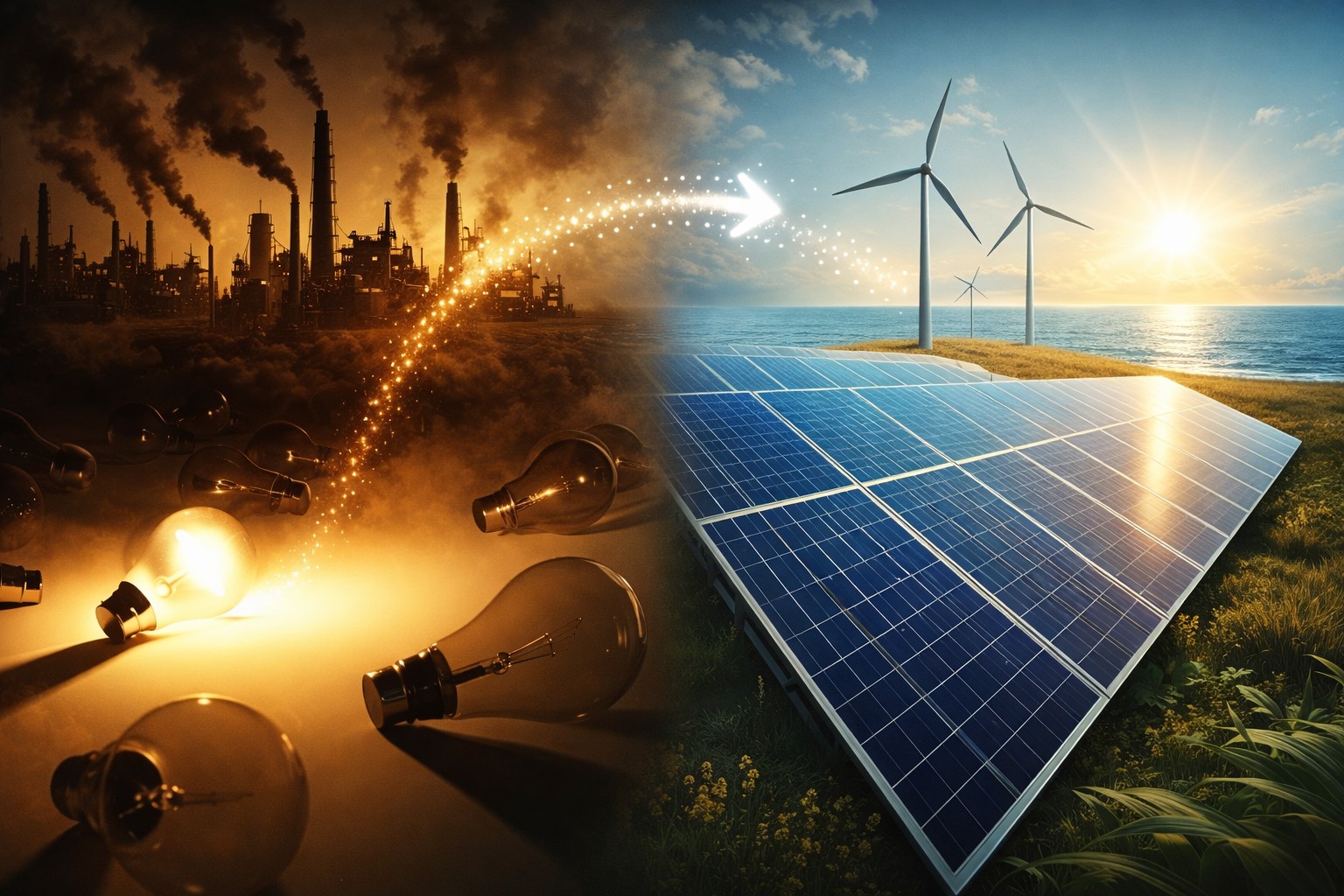
Introduction: The Global Energy Transition From Fossil Fuels to Renewables
The global energy transition from fossil fuels to renewables represents one of the most significant structural shifts in modern economic history. For more than a century, coal, oil, and natural gas have powered industrialization, transportation systems, and global trade networks. Today, however, climate concerns, technological innovation, energy security risks, and geopolitical pressures are accelerating the shift toward renewable energy sources such as solar, wind, hydro, and green hydrogen.
The energy transition is not simply an environmental policy debate. It affects global supply chains, financial markets, labor structures, geopolitical alliances, and inflation dynamics. As countries pursue carbon reduction targets, the balance between energy security, affordability, and sustainability becomes increasingly complex.
Understanding the global energy transition from fossil fuels to renewables requires examining technological advancements, policy frameworks, economic trade-offs, and geopolitical implications.
Why the Energy Transition Is Accelerating
Several factors drive the transition:
- Climate change mitigation commitments
- Technological cost reductions in renewables
- Energy security diversification
- Investor pressure toward sustainable assets
- Public demand for cleaner air and reduced emissions
Institutions such as the International Energy Agency report steady growth in renewable capacity worldwide.
Energy policy is now closely linked to climate targets.
Fossil Fuel Dependence and Structural Challenges
Despite renewable expansion, fossil fuels remain dominant in global energy consumption.
Challenges in transitioning include:
- Existing infrastructure investments
- Employment in fossil fuel industries
- Grid integration limitations
- Energy storage constraints
Countries heavily dependent on fossil fuel exports face economic restructuring pressures.
The shift is gradual rather than abrupt.
Renewable Energy Expansion
Renewable energy sources include:
- Solar photovoltaic systems
- Onshore and offshore wind
- Hydropower
- Biomass
- Geothermal energy
Rapid technological improvements have reduced solar and wind costs significantly over the past decade.
Large economies such as China and United States have expanded renewable installations at scale.
Emerging economies are also increasing investment.
Energy Security and Geopolitical Realignment
The global energy transition from fossil fuels to renewables reshapes geopolitical relationships.
Historically, oil-exporting regions influenced global energy markets. Renewable energy, however, reduces dependence on concentrated fossil fuel reserves.
At the same time, new dependencies emerge:
- Rare earth minerals
- Lithium and cobalt for batteries
- Semiconductor components
As discussed in global supply chains after COVID and conflicts, resource concentration can create strategic vulnerabilities.
Energy security now includes supply chain resilience for critical materials.
Economic Implications and Inflation
Energy prices influence:
- Manufacturing costs
- Transportation expenses
- Household energy bills
Rapid transition policies may raise short-term costs but potentially stabilize long-term price volatility.
As explored in global inflation changing everyday life, energy price fluctuations often transmit directly into broader consumer price levels.
Balancing affordability with sustainability remains a policy challenge.
Labor Market Transformation
The energy transition reshapes employment patterns.
New job growth areas include:
- Renewable installation
- Grid modernization
- Battery manufacturing
- Energy storage engineering
At the same time, fossil fuel sectors may experience employment contraction.
This intersects with broader technological labor shifts discussed in artificial intelligence changing global employment.
Workforce retraining becomes central to equitable transition.
Financial Markets and Green Investment
Financial institutions increasingly integrate environmental metrics into investment decisions.
Green bonds, sustainable investment funds, and climate risk disclosures influence capital allocation.
Institutions such as the World Bank support renewable infrastructure financing in developing economies.
Capital flows shape transition speed.
Infrastructure and Grid Modernization
Renewable energy requires grid upgrades.
Key challenges include:
- Energy storage systems
- Smart grid integration
- Transmission expansion
- Cross-border interconnection
Digital systems enhance grid efficiency and demand forecasting.
The future of cybersecurity in a digital world becomes relevant as energy grids digitize.
Policy Approaches and Climate Targets
Governments employ various mechanisms:
- Carbon pricing
- Emissions trading systems
- Renewable energy mandates
- Subsidies and tax incentives
The European Union has implemented comprehensive climate legislation linking energy policy with emissions reduction goals.
Policy coherence influences investor confidence.
Risks of Fragmentation and Uneven Transition
Transition speeds vary globally.
Advanced economies may move faster due to capital availability and technology access.
Developing nations face:
- Financing constraints
- Infrastructure limitations
- Competing development priorities
Uneven transition could create geopolitical and economic imbalances.
Future Outlook: Structured Energy Diversification
The global energy transition from fossil fuels to renewables is likely to unfold over decades.
Key trends include:
- Increased electrification
- Expansion of green hydrogen
- Greater battery storage capacity
- Continued fossil fuel role during transition
Rather than eliminating fossil fuels immediately, most projections anticipate gradual diversification.
Energy systems may evolve into hybrid models during transition phases.
Frequently Asked Questions
Why is the world transitioning to renewable energy?
Climate change mitigation, falling renewable costs, and energy security concerns are driving the transition.
Will fossil fuels disappear completely?
Most forecasts suggest fossil fuels will decline gradually rather than disappear entirely in the near term.
Does renewable energy reduce geopolitical tension?
Renewables can reduce dependence on concentrated fossil fuel reserves, but new resource dependencies may emerge.
Powering the Future
The global energy transition from fossil fuels to renewables represents a structural transformation of economic systems, trade relationships, labor markets, and geopolitical alignments. While the path forward involves economic trade-offs and technological challenges, the shift reflects long-term strategic adaptation to climate risk and energy security concerns.
Energy systems of the future will likely balance sustainability, affordability, and resilience redefining global power structures in the process.
Revolutionizing Energy: The Potential of Supercritical Geothermal Technology
Editorial Note: This article is intended for informational and educational purposes only. It provides analytical insights based on publicly available information and does not constitute financial, legal, or political advice. Readers are encouraged to consult official sources and expert advisors for verified guidance.