

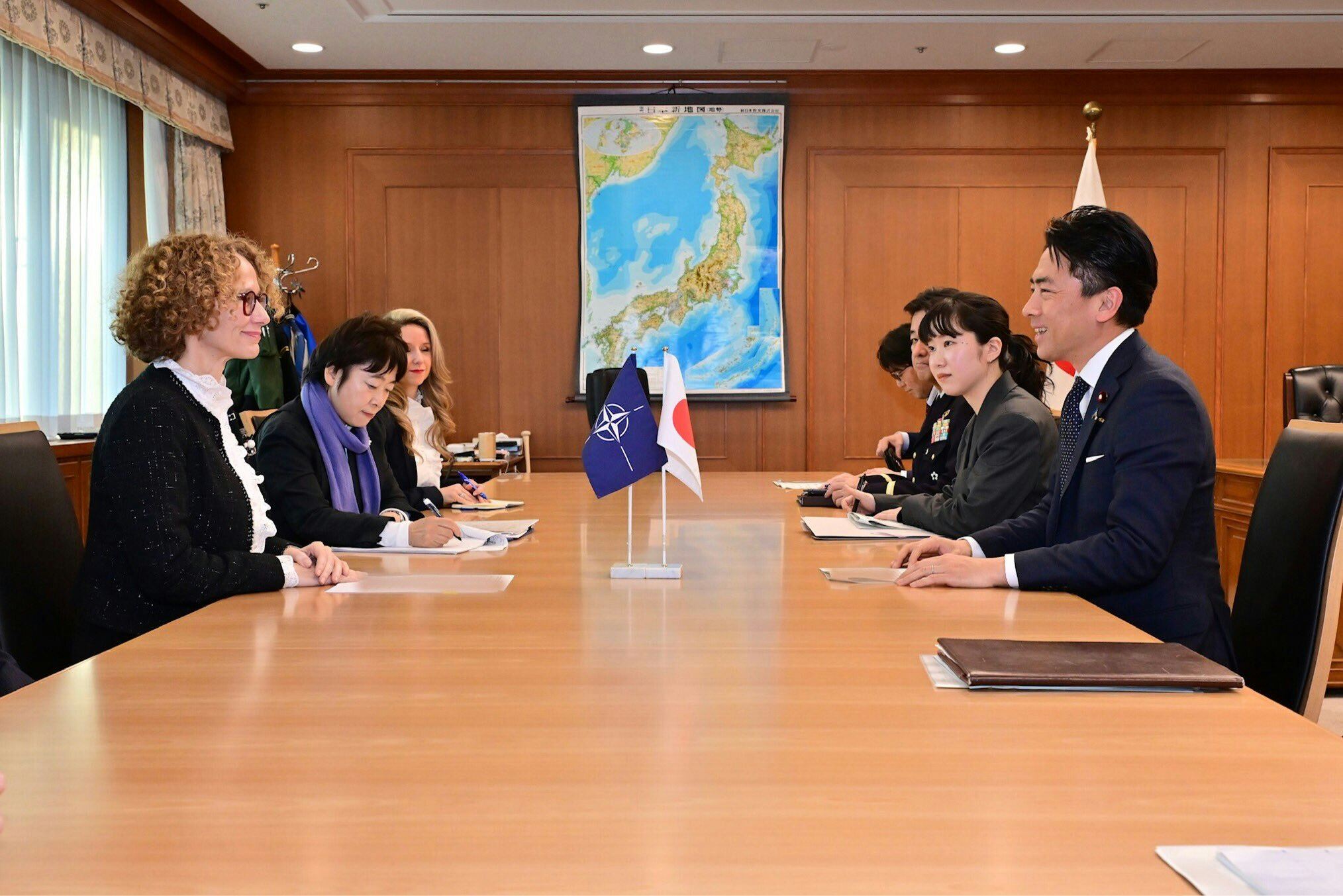
On March 5 and 6, 2026, NATO Deputy Secretary General Radmila Shekerinska conducted a series of strategic engagements in Tokyo, focusing on the deepening ties between the Alliance and its Indo-Pacific partners. The visit included consultations with senior government leaders, lawmakers, and pioneers within Japan’s defense and technology sectors.
Strengthening the Euro-Atlantic and Indo-Pacific Link
During her stay, Ms. Shekerinska held bilateral talks with several key officials, including:
-
Sato Kei, Deputy Chief Cabinet Secretary
-
Koizumi Shinjiro, Minister of Defence
-
Kano Koji, Vice-Minister of Defense for International Affairs
-
Kunimitsu Ayano, State Minister for Foreign Affairs
-
Ino Toshiro, State Minister of Economic, Trade and Industry
Ms. Shekerinska commended Japan’s proactive stance in the current global security climate, specifically highlighting Tokyo’s commitment to raising defense expenditure to 2% of its GDP. She noted that the ongoing conflict in Ukraine serves as a reminder that the security of the Euro-Atlantic and Indo-Pacific regions are fundamentally linked.
Strategic Support and Industrial Cooperation
A major theme of the visit was Japan’s continued assistance to Ukraine. The Deputy Secretary General expressed gratitude for Japan’s contributions via NATO’s Comprehensive Assistance Package (CAP).
Looking toward the future, the discussions emphasized the necessity of collaboration with “like-minded” partners. Key priorities for the NATO-Japan partnership now include:
-
Defense industrial synergy
-
Space exploration and security
-
Technological innovation
Field Visits and Parliamentary Engagement
Beyond policy discussions, Ms. Shekerinska met with representatives of the National Diet (Japan’s parliament) and visited critical defense and tech sites. These included:
-
Atsugi Air Base: To observe the Patriot Advanced Capability-3 (PAC-3) system.
-
Synspective: A Japanese leader in radar-imaging technology.
While speaking at an event co-hosted by the Japan Institute of International Affairs (JIIA) and the embassies of Norway and Romania, Shekerinska discussed the road ahead for the Alliance. She emphasized that while many allies have increased their investments, there is a vital need to boost production capabilities across the board to ensure collective safety.
Source: This article contains information originally reported by NATO.
Who is Synspective?
Based in Tokyo, Synspective Inc. is a global leader in high-frequency Earth observation. Founded in 2018, the company has pioneered the use of small Synthetic Aperture Radar (SAR) satellites—tech that allows for “24/7” monitoring of the planet.
Unlike traditional satellites that rely on sunlight, Synspective’s StriX constellation uses radar waves to “see” through thick clouds, heavy rain, and total darkness. This makes their data invaluable for:
- National Security: Persistent monitoring of borders and maritime activity.
- Disaster Response: Assessing flood damage or landslides in real-time, even during storms.
- Infrastructure: Detecting millimeter-level ground movement to prevent sinkholes or bridge failures.
In early 2026, Synspective reached a major milestone by joining a ¥283 billion (approx. $1.9 billion) project with the Japanese Ministry of Defense to build a sovereign satellite constellation, further cementing its role as a key player in international security.
Learn More
For a deeper look at their satellite technology and global missions, visit the official website: Explore Synspective
Inside Synspective: Japan’s Eyes in the Sky
One of the most tech-forward stops on Ms. Shekerinska’s Tokyo itinerary was Synspective, a trailblazing Japanese aerospace startup that is rapidly becoming a cornerstone of Indo-Pacific security. Founded in 2018, Synspective specializes in Synthetic Aperture Radar (SAR) satellite technology a field that has become essential for modern military intelligence and disaster resilience.
The Power of SAR Technology
Traditional optical satellites work much like a standard camera; they require sunlight and clear skies to capture an image. If it’s nighttime or cloudy, they are essentially blind. Synspective’s StriX constellation changes the game.
SAR satellites emit their own microwave signals that bounce off the Earth’s surface and return to the sensor. This allows them to “see” through:
- Thick cloud cover and rain
- Total darkness
- Smoke, haze, and dust
For an alliance like NATO, this “all-weather, 24/7” capability is vital. It allows for the persistent monitoring of troop movements, infrastructure changes, and maritime activity in real-time, regardless of environmental conditions.
A Strategic Partner for National Defense
The timing of the NATO visit is no coincidence. In early 2026, Synspective secured a landmark subcontract as part of the Japanese Ministry of Defense’s new satellite constellation project. This initiative aims to build a sovereign, high-frequency monitoring network that reduces reliance on foreign intelligence assets.
Ms. Shekerinska’s visit highlights how commercial innovation is now fueling national security. By visiting Synspective, NATO is acknowledging that the future of the alliance depends on “SmallSat” constellations groups of smaller, more affordable satellites that can provide a “revisit rate” (how often they pass over the same spot) far faster than the massive, multi-billion-dollar satellites of the past.
Global Implications and NATO Cooperation
Synspective’s technology isn’t just for Japan; the company recently expanded into Europe with a new subsidiary in Munich and signed a strategic data-sharing agreement with Airbus Defence and Space – Read More
As Ms. Shekerinska noted during her visit, the security of the Euro-Atlantic and the Indo-Pacific is now interconnected. In a world where “information superiority” determines the outcome of conflicts, Synspective’s ability to provide millimeter-level ground deformation data and high-resolution imagery makes it a key player in the “industrial cooperation” NATO is seeking with its Japanese partners.
Editorial Note: This article is intended for informational and educational purposes only. It provides analytical insights based on publicly available information and does not constitute financial, legal, or political advice. Readers are encouraged to consult official sources and expert advisors for verified guidance.