

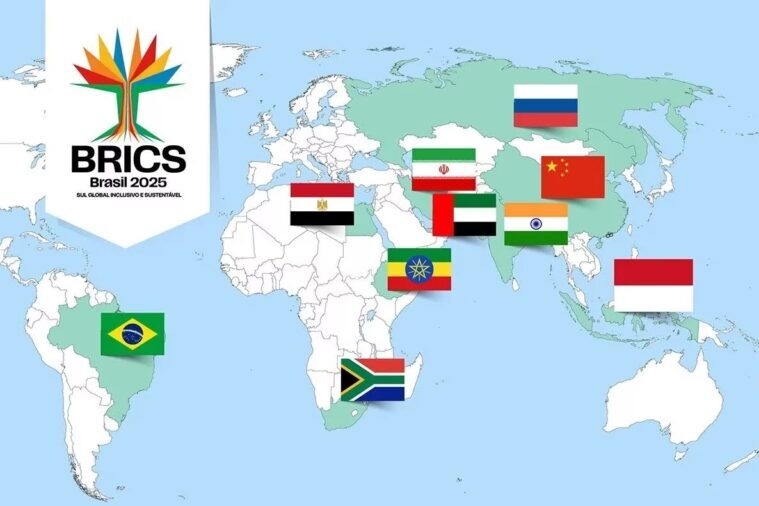
Introduction: BRICS Reshaping the Global Economic Order
The phrase BRICS reshaping the global economic order is no longer speculative analysis it has become a central theme in global economic discussions. Over the past decade, the bloc known as BRICS has expanded its ambitions beyond symbolic cooperation and into concrete financial, diplomatic, and structural reforms that challenge traditional Western-led institutions.
Originally formed by Brazil, Russia, India, China, and South Africa, BRICS now represents more than 40% of the world’s population and a growing share of global GDP (PPP-adjusted). Recent expansion efforts signal that the grouping seeks not merely cooperation, but structural influence over trade systems, financial governance, and geopolitical alignment.
This article examines how BRICS is reshaping the global economic order, why this shift matters internationally, and what it could mean for the coming decades.
Historical Background: From Investment Acronym to Strategic Bloc
The term “BRIC” was first coined in 2001 by an economist at Goldman Sachs to describe emerging economies with high growth potential. At the time, it was a market classification, not a political alliance.
However, by 2009, the countries formalized annual summits. South Africa joined in 2010, forming BRICS. The bloc gradually shifted from economic branding to political coordination, particularly in response to dissatisfaction with institutions such as the:
- International Monetary Fund
- World Bank
- World Trade Organization
Emerging economies often argued that voting structures in these institutions favored Western powers disproportionately. Calls for reform gained momentum after the 2008 global financial crisis, when advanced economies required stabilization despite historically promoting financial discipline abroad.
In 2014, BRICS launched the New Development Bank (NDB), designed to finance infrastructure and sustainable development projects. This marked the first tangible institutional step toward reshaping global financial architecture.
Current Developments: Expansion, Currency Dialogue, and Strategic Coordination
The last few years have accelerated discussion around BRICS reshaping the global economic order. Key developments include:
- Expansion Beyond the Original Five
Several countries across the Middle East, Africa, and Latin America have expressed interest in joining or partnering with BRICS. Expansion signals an ambition to build a broader coalition of developing and middle-income economies seeking alternative platforms for cooperation.
- De-Dollarization Discussions
BRICS members have increased trade settlement in local currencies. While the United States dollar remains dominant globally, conversations around reducing dependency have intensified — particularly after financial sanctions imposed on Russia in 2022.
Though a single BRICS currency remains speculative, cross-border payment systems and bilateral currency swaps are expanding.
- Infrastructure Financing and South-South Cooperation
The New Development Bank has funded projects in renewable energy, transport infrastructure, and sustainable urban development. Unlike traditional lenders, BRICS institutions position themselves as flexible and less politically conditional.
- Strategic Economic Dialogue
The bloc increasingly coordinates positions on trade policy, digital economy governance, and climate financing within multilateral forums such as the G20.
These developments reflect not abrupt revolution, but gradual structural repositioning.
Global Impact: Trade, Finance, and Power Distribution
If BRICS continues on its current trajectory, its influence may manifest across several domains:
Trade Patterns
Growing South-South trade reduces reliance on traditional North Atlantic corridors. China and India have strengthened trade ties with Africa and Latin America, while Brazil has expanded agricultural exports to Asian markets.
Shifting trade routes alter supply chains and reduce dependency on Western intermediaries.
Financial Architecture
The potential development of alternative settlement systems could:
- Lower transaction costs for member states
- Reduce exposure to sanctions
- Encourage diversification of reserve assets
However, replacing entrenched systems such as SWIFT would require scale, trust, and regulatory coordination.
Geopolitical Balance
The global economic order since World War II has largely been shaped by Western-led institutions. A strengthened BRICS coalition introduces a more multipolar structure, diffusing influence rather than centralizing it.
This does not necessarily imply confrontation. Rather, it suggests parallel frameworks coexisting alongside established institutions.
Technology and Development Strategy
Technology governance is emerging as a defining frontier. As artificial intelligence, digital currencies, and cybersecurity policies shape economic competition, BRICS countries are positioning themselves as major technology hubs.
China and India have developed significant digital infrastructure ecosystems. Meanwhile, Brazil and South Africa are investing in green energy technologies and digital inclusion strategies.
Coordination in these sectors may enhance bargaining power in global regulatory debates.
Risks and Constraints
Despite growing momentum, BRICS faces structural challenges:
Internal Diversity
Members differ significantly in political systems, economic models, and foreign policy priorities. Aligning consensus across such diversity requires diplomatic flexibility.
Economic Asymmetry
China’s economic weight surpasses other members combined. Balancing influence internally remains a delicate task.
Institutional Capacity
Building credible alternatives to established global institutions requires long-term stability, transparency, and investor confidence.
Currency Realities
The US dollar remains deeply embedded in global finance. Even incremental diversification would take years to materialize meaningfully.
Future Outlook: Gradual Transformation Rather Than Sudden Shift
The most realistic scenario is not the collapse of the existing system, but layered transformation.
Possible outcomes include:
- Parallel financial institutions operating alongside IMF and World Bank structures.
- Increased use of local currencies in regional trade.
- Expanded infrastructure investment flows toward developing economies.
- A stronger collective negotiating position in climate and trade talks.
Multipolarity may define the 21st century not through abrupt upheaval, but through incremental shifts in influence.
Why This Matters for Everyday Economies
For citizens globally, BRICS reshaping the global economic order may influence:
- Energy prices
- Trade tariffs
- Investment flows
- Infrastructure development
- Currency stability
Latest Updates
Key Developments in early 2026:
- India’s 2026 Chairmanship: India officially assumed the BRICS Chairmanship on January 1, 2026, under the theme “Building for Resilience, Innovation, Cooperation, and Sustainability.” The focus has shifted toward practical, people-centric cooperation in digital public infrastructure (DPI), AI governance, and resilient supply chains for critical minerals.
- Expansion of the “Partner Country” Model: Following the 2025 Rio de Janeiro Summit, BRICS is refining a tiered membership structure. Rather than immediate full membership for all applicants, the bloc is utilizing a “Partner Country” status to integrate nations like Indonesia, Vietnam, and Nigeria into its economic framework without diluting its decision-making core.
- The De-Dollarization Reality: While rhetoric regarding a “BRICS Currency” remains high, the practical focus in 2026 is on BRICS Pay a digital clearing platform intended to bypass the SWIFT system and increasing bilateral trade in local currencies. Notably, India and Brazil recently reaffirmed their commitment to doubling bilateral trade to $30 billion by 2030, emphasizing settlements in rupees and reals to mitigate the impact of external exchange rate volatility.
- Geopolitical Balancing: Recent high-level meetings, including the February 2026 visit of Brazilian President Lula to New Delhi, underscore a push for United Nations Security Council (UNSC) reform, with members seeking a permanent voice for the “Global Majority.”
As of February 2026, the landscape for BRICS has shifted from theoretical debate to technical implementation. Under India’s 2026 Chairmanship, the focus is on digital infrastructure rather than just political rhetoric.
FAQ – Frequently Answered Questions
- What is the main goal of BRICS?
As of 2026, the main goal has evolved into building “Strategic Autonomy” through technical interoperability. Under the theme “Building for Resilience, Innovation, Cooperation, and Sustainability,” India is steering the bloc toward creating Digital Public Infrastructure (DPI). The aim is to allow member nations to trade and share data using their own sovereign systems (like the “India Stack” or Brazil’s “Drex”) while bypassing traditional Western-led financial bottlenecks.
- Is BRICS creating a new global currency?
No. In February 2026, Brazilian President Lula da Silva explicitly clarified that there is no formal proposal for a unified BRICS currency, calling the rumors “misunderstood.” Instead, the bloc has launched BRICS Pay, a decentralized payment messaging system that acts as an alternative to SWIFT. This allows countries to settle trades in their own local currencies (e.g., Rupees, Reals, Yuan) via a digital clearing platform, rather than needing a single new physical currency.
- How does BRICS affect the US dollar?
While the US dollar remains the world’s primary reserve currency, its share in global reserves has dipped slightly to approximately 56% in early 2026. The “threat” to the dollar is no longer an overnight replacement, but rather “fragmentation.” By settling over 60% of intra-bloc trade in local currencies and increasing gold reserves (central banks bought over 1,100 tons in 2025), BRICS is creating a parallel system that makes the dollar “optional” for specific trade routes, particularly in energy and critical minerals.
Latest News Links (February 2026)
- India & Brazil Sign Rare Earths Pact; Lula Debunks Currency Rumors – Detailed report on the Feb 21, 2026, bilateral summit in New Delhi.
- BRICS Pay Launches as Independent SWIFT Alternative – Official status update on the 2026 operational phase of the payment system.
- India Assumes BRICS Presidency: Focus on AI and Digital Sovereignty – Coverage of the AI Impact Summit and India’s leadership goals for the year.
A Structural Evolution in Motion
The concept of BRICS reshaping the global economic order reflects a broader shift toward multipolar governance. Rather than replacing existing institutions outright, BRICS appears focused on building complementary mechanisms that expand options for emerging economies. Whether this transformation accelerates or stabilizes will depend on internal cohesion, global economic conditions, and the responses of established powers. What is clear is that the global economic architecture is no longer static. It is adapting and BRICS is playing a visible role in that evolution. By 2026, this evolution is manifested in the group’s transition from a purely political forum into a technical and financial alternative, marked by the operationalization of cross-border digital payment systems and a strategic pivot toward securing the Global South’s technological and mineral sovereignty.
SOURCE : BRICS
Editorial Note: This article is intended for informational and educational purposes only. It provides analytical insights based on publicly available information and does not constitute financial, legal, or political advice. Readers are encouraged to consult official sources and expert advisors for verified guidance.