

Introduction: The Role of International Organizations in Crisis Management
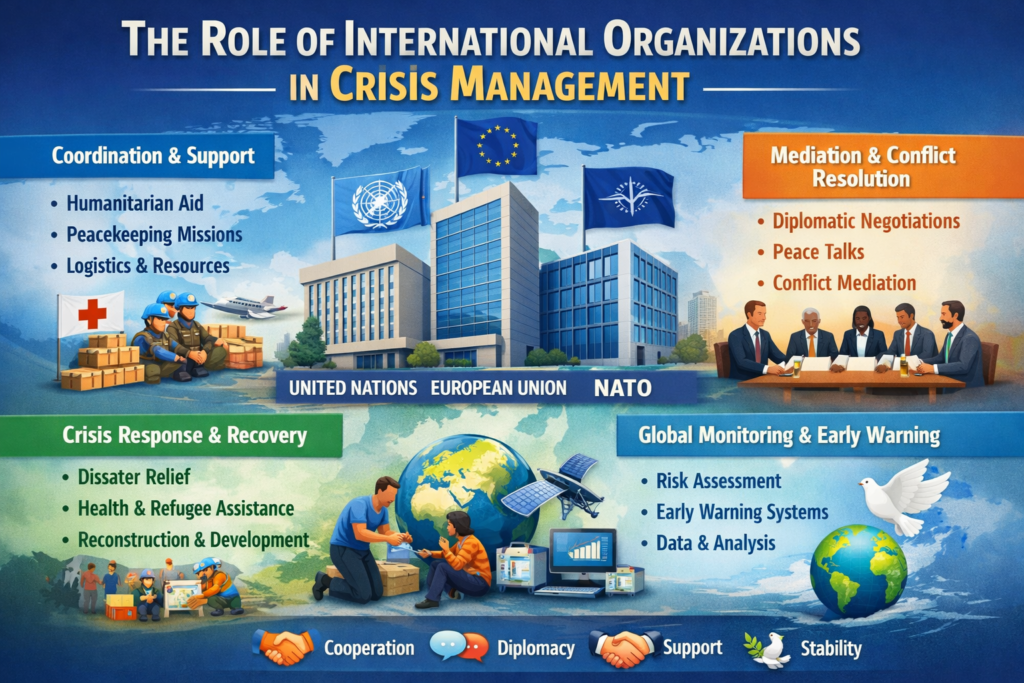
The role of international organizations in crisis management has become increasingly central in a world characterized by interconnected risks. From pandemics and armed conflicts to climate disasters and financial instability, crises rarely remain confined within national borders. International organizations serve as coordination platforms, funding channels, diplomatic intermediaries, and technical advisors in moments of global stress.
In the 21st century, crises unfold rapidly due to globalization, digital communication networks, and economic interdependence. National governments often lack sufficient resources or jurisdiction to respond alone.
International institutions attempt to bridge these gaps by facilitating cooperation, sharing information, mobilizing financial assistance, and establishing normative frameworks.
Understanding the role of international organizations in crisis management requires examining humanitarian response mechanisms, peacekeeping frameworks, financial stabilization tools, health governance systems, and emerging digital coordination strategies.
Why International Coordination Matters
Modern crises frequently exhibit cross-border characteristics:
- Infectious disease transmission
- Refugee flows
- Financial contagion
- Climate-induced disasters
- Cybersecurity threats
No single country can independently manage these challenges when impacts extend across regions.
International organizations provide:
- Multilateral negotiation platforms
- Shared funding mechanisms
- Technical expertise
- Policy guidance
- Conflict mediation
Coordination reduces duplication of effort and enhances efficiency in emergency response.
Humanitarian Crisis Response
Humanitarian emergencies often require immediate assistance.
The United Nations coordinates global humanitarian relief through agencies focused on food security, refugee protection, and disaster response.
These agencies mobilize:
- Emergency food distribution
- Temporary shelter
- Medical supplies
- Water sanitation systems
Humanitarian operations depend heavily on international funding and logistical coordination.
However, political constraints and funding shortfalls can limit effectiveness.
Health Emergencies and Pandemic Management
Global health crises demonstrate the necessity of coordinated action.
The World Health Organization provides disease surveillance guidance, emergency declarations, and international health regulation frameworks.
During pandemics, international organizations facilitate:
- Data sharing
- Research collaboration
- Vaccine distribution initiatives
- Public health guidance
While coordination improved scientific collaboration, political tensions occasionally hindered unified response.
Strengthening transparency and compliance remains central to future reform discussions.
Peacekeeping and Conflict Mediation
Armed conflict generates displacement, economic disruption, and regional instability.
International organizations deploy peacekeeping missions, mediation teams, and monitoring frameworks.
Peacekeeping operations aim to:
- Protect civilians
- Support ceasefire agreements
- Facilitate political dialogue
- Stabilize post-conflict regions
These missions require multilateral consensus and sustained funding.
Operational success often depends on cooperation between host governments and international actors.
Financial Crisis Management
Economic crises can rapidly spread through interconnected markets.
Institutions such as the International Monetary Fund and the World Bank provide financial assistance and policy guidance during economic instability.
Their functions include:
- Emergency lending
- Debt restructuring frameworks
- Technical advisory support
- Macroeconomic stabilization programs
Financial crisis management highlights the intersection between sovereignty and international conditionality.
Debates continue regarding fairness and representation within these institutions.
Climate and Environmental Disaster Response
Climate-related disasters require coordinated action.
International organizations support:
- Disaster relief funding
- Climate adaptation projects
- Environmental risk assessment
- Cross-border resource management
Multilateral climate agreements aim to mitigate environmental risk while facilitating sustainable development.
However, implementation gaps persist between commitments and outcomes.
Refugee Protection and Migration Governance
Conflict and climate displacement increase refugee flows.
The United Nations High Commissioner for Refugees coordinates refugee protection, resettlement efforts, and emergency assistance.
Refugee governance involves balancing:
- Humanitarian obligations
- National sovereignty
- Regional burden-sharing mechanisms
Coordination improves resource distribution but depends on political cooperation.
Digital Infrastructure and Crisis Communication
Digital technologies enhance crisis response capacity.
International organizations now utilize:
- Real-time data dashboards
- Satellite imagery
- AI-based predictive modeling
- Digital funding platforms
Digital communication allows faster coordination but also introduces cybersecurity vulnerabilities.
Effective crisis management increasingly requires technological competence.
Challenges Facing International Organizations
Despite their importance, international organizations face structural challenges:
- Funding volatility
- Political polarization among member states
- Bureaucratic complexity
- Limited enforcement authority
- Representation imbalance
Geopolitical rivalry can undermine consensus-building.
Institutional reform debates focus on transparency, accountability, and efficiency.
Sovereignty and Multilateralism
Crisis management often tests the balance between national sovereignty and multilateral cooperation.
Countries may resist external oversight during emergencies.
At the same time, shared risk necessitates cooperation.
Multilateralism depends on trust and shared responsibility.
Institutional legitimacy influences compliance and coordination success.
Funding and Resource Allocation
International organizations rely on:
- Member state contributions
- Voluntary funding
- Development grants
Funding imbalances can skew priorities.
Sustainable crisis response requires predictable financial commitments.
Fiscal uncertainty limits long-term planning.
Emerging Crisis Domains
Future crisis domains may include:
- Cyber warfare
- Artificial intelligence misuse
- Space infrastructure disruptions
- Water scarcity conflicts
International institutions must adapt to evolving risk landscapes.
Anticipatory governance is becoming increasingly relevant.
Reform and Institutional Evolution
Reform proposals often include:
- Expanded representation for emerging economies
- Greater transparency mechanisms
- Streamlined decision-making processes
- Enhanced rapid response authority
Institutional evolution may determine long-term relevance.
Balancing agility with legitimacy remains complex.
The Future of Multilateral Crisis Governance
The role of international organizations in crisis management is unlikely to diminish.
Instead, coordination mechanisms may become more specialized and regionally integrated.
Hybrid governance models combining:
- Public institutions
- Private sector partnerships
- Civil society organizations
may enhance crisis resilience.
Global interdependence ensures continued demand for cooperative frameworks.
List of few International Organizations & their roles :
- The World Health Organization (WHO)
The WHO serves as the directing and coordinating authority for international health within the United Nations system. In 2026, its role has shifted from general oversight to the operational management of the Pathogen Access and Benefit-Sharing (PABS) System. The organization facilitates the rapid sharing of viral data while ensuring that developing nations receive equitable access to the vaccines and treatments derived from that data.
Beyond pandemics, the WHO manages the “Global Health Emergency Corps,” a workforce ready to deploy to regions facing sudden outbreaks or the health impacts of climate-related disasters.
- United Nations Office for the Coordination of Humanitarian Affairs (OCHA)
OCHA is the central hub for the global humanitarian response. In January 2026, OCHA launched its Global Humanitarian Overview, aiming to assist 135 million people across 32 countries.
Its primary role is to ensure that various relief agencies such as the WFP and UNICEF do not duplicate efforts. OCHA manages the Central Emergency Response Fund (CERF), which allows for the immediate release of money when a crisis hits, such as a sudden conflict or an earthquake, ensuring that aid reaches the ground within hours rather than weeks.
- The International Monetary Fund (IMF) and World Bank
These “Bretton Woods” institutions manage the economic fallout of global crises. The IMF acts as a global “lender of last resort,” providing emergency financial assistance to countries facing balance-of-payments crises, such as those caused by the $1 trillion annual economic toll of Long COVID. Meanwhile, the World Bank focuses on long-term structural resilience.
In 2026, the Bank is heavily involved in “Climate-Resilient Development,” funding the hardening of infrastructure in nations vulnerable to extreme weather to prevent environmental shocks from becoming full-scale economic collapses.
- The International Organization for Migration (IOM)
As the leading agency for “people on the move,” the IOM’s role has become critical due to increased climate-induced displacement. In 2026, the IOM manages the Global Crisis Response Platform, which tracks migration patterns in real-time using AI and satellite data.
Their mandate includes providing life-saving assistance to internally displaced persons (IDPs), managing refugee camps, and advising governments on creating safe, legal pathways for migration to prevent the humanitarian tragedies often seen at border crossings during regional instabilities.
- The International Committee of the Red Cross (ICRC)
While not a UN body, the ICRC is a unique international organization with a specific legal mandate under the Geneva Conventions. In 2026, the ICRC remains the primary neutral intermediary in armed conflicts. Its role is twofold: providing direct humanitarian aid (food, water, and medical care) in “active” war zones where UN agencies may struggle to operate, and monitoring the treatment of prisoners of war.
In the current era, the ICRC is also a leading voice in the regulation of Autonomous Weapon Systems, advocating for human control in crisis-driven combat scenarios.
- United Nations Office for Disaster Risk Reduction (UNDRR)
The UNDRR focuses on “pre-crisis” management. Its role is to implement the Sendai Framework, helping nations identify vulnerabilities before a disaster occurs. In 2026, they lead the global effort in “Early Warning for All,” a program ensuring that every person on Earth is protected by early warning systems for floods, storms, and heatwaves.
By transforming data into actionable alerts, the UNDRR reduces the mortality rate of predictable crises.
Frequently Asked Questions
Why are international organizations important during crises?
They coordinate resources, share information, provide funding, and facilitate diplomatic solutions when crises cross national borders.
Do international organizations have enforcement power?
Most rely on member state cooperation rather than direct enforcement authority.
Can international organizations prevent future crises?
They cannot eliminate crises but can improve preparedness, coordination, and response effectiveness.
Cooperation in an Interconnected World
The role of international organizations in crisis management reflects the recognition that modern risks transcend borders. Whether addressing pandemics, armed conflict, financial instability, or climate disasters, coordinated multilateral action enhances response capacity.
While institutional limitations remain, global interdependence makes cooperation indispensable.
Strengthening governance frameworks, improving transparency, and adapting to emerging threats will shape the effectiveness of international organizations in future crises.
Editorial Note: This article is intended for informational and educational purposes only. It provides analytical insights based on publicly available information and does not constitute financial, legal, or political advice. Readers are encouraged to consult official sources and expert advisors for verified guidance.